SDG 1
No Poverty
Rajamangala University of Technology Lanna (RMUTL) | Sustainability Report 2025
SDG 1 Highlights 2025
Expanding Educational Opportunities and Financial Support
In 2025, Rajamangala University of Technology Lanna (RMUTL) continued its commitment to reducing financial barriers to education through scholarships, student loans, emergency assistance, and targeted support for disadvantaged students across its six campus areas.
The university recorded 527 recipients of non-repayable grants totaling THB 4.50 million. In addition, 3,714 students accessed the Student Loan Fund (SLF), including 759 new borrowers and 2,955 continuing borrowers. These financial support mechanisms help students manage educational expenses and maintain access to higher education.
Strengthening Educational Equity through National Scholarship Programs
RMUTL strengthened its collaboration with the Equitable Education Fund (EEF) through the High Vocational Innovation Scholarship Program, Cohort 7, and the Phra Kanit Sammajiv Scholarship Program. These initiatives expand educational opportunities for academically capable students from low-income and disadvantaged backgrounds.
In 2025, RMUTL Chiang Rai Campus received an additional allocation of 25 High Vocational Innovation Scholarships in Electric Vehicle Technology and Electronics (Medical Technology). The programs support technical skills development and provide pathways to vocational qualifications and future employment.
Providing Emergency Assistance and Living Support
RMUTL provided emergency financial assistance to 92 students, totaling THB 580,000, to help address severe financial hardship and unexpected circumstances affecting their education.
The university also provided student accommodation services and promoted income-generating opportunities to help reduce living expenses, particularly for students from low-income families and those living far from campus.
Promoting Career Development and Economic Opportunities
RMUTL supported career readiness and practical skills development through cooperative education, work-based learning, student entrepreneurship, and opportunities for part-time employment.
In academic year 2025, 1,435 students participated in cooperative education courses across the university’s six campus areas. These programs provided opportunities to gain professional experience, develop industry-relevant competencies, and prepare for future employment.
Together, these initiatives demonstrate RMUTL’s approach to improving educational access, supporting students’ financial well-being, and strengthening long-term economic opportunities for students and their families.
For more than 50 years as an educational institution and over 20 years as a university, RMUTL has remained committed to providing education that leads to careers. We believe that having a profession is a pathway to sustainably lifting society out of poverty.
RMUTL: Educational Opportunities for All
RMUTL also maintains a social protection floor to combat poverty through strong policy structures and practical implementation, as summarized in Table 1.1.
“The University shall not refuse admission to any person, or terminate or suspend any student’s studies, solely because that person lacks the financial means to pay the various fees charged by the University …”
Rajamangala University of Technology Act, B.E. 2548 (2005), Chapter 1: General Provisions, Section 11
All types of scholarships, Grants (external/internal), emergency assistance, equity support, and employment while studying | Areas of responsibility and care, with care extending beyond boundaries | Projects/cooperation to eradicate poverty Agriculture, fisheries, livestock, food, water, and vocational training accessible to all | |||
Students | Staff | Communities across six northern provinces | Youth from neighboring low-income countries such as Myanmar and Laos | ||
Areas of responsibility and care, with care extending beyond boundaries | |||||
Table 1.1. RMUTL’s Social Protection Floor for Poverty Eradication
Philosophy:[1]
“Leading University of Technology and Innovation for Sustainable Communities”
Philosophy of education:
“Focusing on producing professional hands-on graduates to create technology and innovations for sustainable community”
Vision:
“Leading professional university in technology and innovation, producing graduate practitioners, innovators, and entrepreneurs to raise the quality of life of society, communities, and locals sustainably.”
Mission:
- Produce professional graduates with competency in technology and innovation to become entrepreneurs.
- Conduct research to develop technology and innovations that respond to the needs of society, communities, and localities.
- Provide academic services through the application of technology and innovation.
- Maintain and expand arts and culture, and conserve the environment for sustainability.
[1] https://www.rmutl.ac.th/page/vision?lang=en
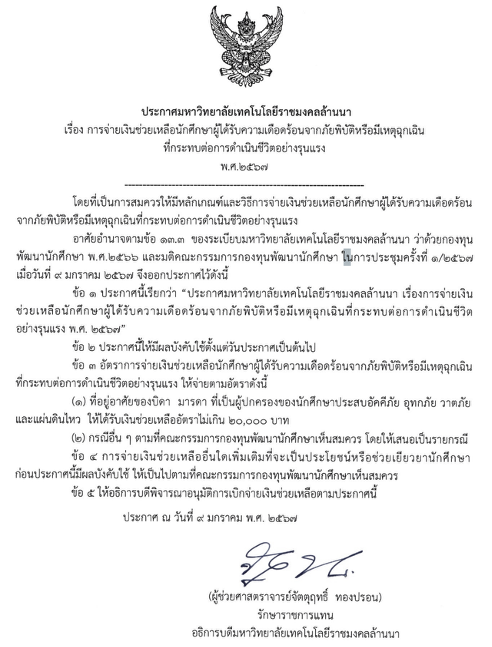
Figure 1.1. Announcement on financial assistance for students affected by disasters or emergencies that seriously disrupt their lives (B.E. 2567/2024).
According to RMUTL’s Office of Academic Affairs and Registration, the university had 15,352 students in academic year 2025. Of these, 527 students received non-repayable grants (Group 1), representing 3.43% of the total student population. This demonstrates RMUTL’s ongoing social protection efforts to prevent students facing financial constraints from dropping out. Free education, scholarships, and living allowances are important tools for breaking the intergenerational cycle of poverty by investing in human capital, improving students’ employment prospects, and helping their families move out of poverty.
RMUTL's Student Financial Support
Scholarships and Living-Support Funds
A total of 92 students received urgent assistance for emergencies that seriously affected their lives during the academic term. This university policy aims to reduce the risk of students and personnel experiencing sudden poverty. Under the 2024 announcement, students may receive up to THB 20,000 when a parent’s or guardian’s residence is affected by a disaster such as a fire, flood, storm, or earthquake.
No. | Scholarship / assistance type | Students supported | Amount (THB) |
Group 1: Non-repayable grants | |||
1.1 | Graduate scholarship (Kaew Yot Kham Lanna) | 6 | 820,000.00 |
1.2 | Academic excellence scholarship | 326 | 1,630,000.00 |
1.3 | Chaloem Ratchakumari Scholarship | 44 | 1,180,500.00 |
1.4 | Scholarship for financially disadvantaged students with volunteer spirit | 1 | 24,000.00 |
1.5 | Emergency assistance for students experiencing severe hardship or life-disrupting emergencies | 92 | 580,000.00 |
1.6 | Awards for outstanding activities | 58 | 262,000.00 |
Total | 527 | 4,496,500.00 | |
Group 2: Student Loan Fund (continuing borrowers advancing to the next year, Chiang Mai area) | |||
2.1 | Financially disadvantaged students | 707 | 9,782,550.00 |
2.2 | Financially disadvantaged students in high-demand fields | 938 | 14,751,500.00 |
2.3 | Financially disadvantaged students in fields with shortages or specially promoted fields | 55 | 687,500.00 |
Total | 1,700 | 25,221,550.00 | |
Table 1.2. Scholarships and Living-Support Funds by Type, Academic Year 2025
Student Loan Fund
Group 2 covers 1,700 continuing Student Loan Fund borrowers advancing to the next academic year in the Chiang Mai area. Together with the 527 students receiving grants (3.43% of all students), these borrowers represent approximately 11.07% of the 15,352 students. Combined, 2,227 students, or 14.51% of the student population, receive financial support. This illustrates how student loans help young people continue their education and avoid dropping out because of sudden financial hardship.
No. | Campus area | Continuing borrowers | New borrowers | Total |
1 | Chiang Mai | 1,747 | 405 | 2,152 |
2 | Tak | 478 | 155 | 633 |
3 | Phitsanulok | 223 | 58 | 281 |
4 | Lampang | 136 | 45 | 181 |
5 | Nan | 117 | 32 | 149 |
6 | Chiang Rai | 254 | 64 | 318 |
| Total | 2,955 | 759 | 3,714 |
Table 1.3. RMUTL Students Borrowing from the Student Loan Fund by Campus Area, Academic Year 2025
RMUTL operates across six provinces in northern Thailand, near lower-income neighboring countries such as Laos and Myanmar, and areas home to ethnic communities, migrants, and displaced people. The region also faces natural disasters, including floods, flash floods, landslides, and earthquakes, which have become more frequent or severe in recent years. Many communities rely on agriculture, wage labor, or small local businesses. Student loans therefore support not only education but, in some cases, students’ families and younger siblings who are still in school.
Across all six campus areas, 3,714 students borrowed from the Student Loan Fund: 2,955 continuing borrowers and 759 new borrowers. Chiang Mai accounts for 2,152 borrowers (57.94%), reflecting its status as the university’s largest area and its employment opportunities and relatively low cost of living. Tak ranks second, with 633 borrowers (17.04%), including students from ethnic communities and remote areas. Access to student loans helps promote equity and reduce poverty in marginalized areas.
No. | Campus area | Continuing borrowers | New borrowers | Total borrowers | New borrowers as % of total |
1 | Chiang Mai | 1,747 | 405 | 2,152 | 18.82% |
2 | Tak | 478 | 155 | 633 | 24.49% |
3 | Chiang Rai | 254 | 64 | 318 | 20.13% |
4 | Phitsanulok | 223 | 58 | 281 | 20.64% |
5 | Lampang | 136 | 45 | 181 | 24.86% |
6 | Nan | 117 | 32 | 149 | 21.48% |
| All areas | 2,955 | 759 | 3,714 | 20.44% |
Table 1.4. New Borrowers and Access to Financial Assistance
The proportion of new borrowers provides insight into both the scale of financial hardship and the effectiveness of access to assistance. Lampang and Tak have the highest shares of new borrowers, at 24.86% and 24.49%, respectively. Nearly one in four borrowers in these areas is newly entering the system, suggesting that regional economic conditions are placing substantial pressure on households. RMUTL should therefore monitor these trends and prepare emergency funds. Overall, new borrowers account for 20.44%, or about one in five borrowers, indicating that the loan system continues to reach new generations of students.
Using the figures for Group 2 in Table 1.2 and statistical extrapolation, RMUTL estimates total Student Loan Fund financing across all areas at approximately THB 55,101,668.65. The estimated amount for 2,955 continuing borrowers is THB 43,840,988.38, while the estimate for 759 new borrowers is THB 11,260,680.26. These estimates illustrate the scale of RMUTL’s social protection efforts and its role in reducing educational inequality in northern Thailand. The Student Loan Fund is an important means of addressing poverty in all its forms across all campus areas. Students experiencing short-, medium-, or long-term poverty may apply for low-interest loans, which can be repaid after two years of employment.
RMUTL’s Understanding of Poverty and Support Measures
These measures target particular groups, but any student experiencing poverty at any stage may apply for support if they meet the eligibility requirements of the relevant fund.
Category | Short-term poverty | Medium-term poverty | Long-term poverty |
Definition | Often occurs unexpectedly because of job loss, illness, bereavement, or natural disasters, resulting in lost income and an immediate need for assistance. | Lasts longer and may arise from income constraints, structural economic conditions, or lack of skills, making it difficult to escape. | Persists across generations and becomes part of everyday life, often due to limited resources, opportunities, and education. |
Support Measures | |||
Disaster / emergency grants | / | ||
Student Loan Fund | / | ||
Equitable Education Fund | / | ||
Other internal and external scholarships | / | / | / |
Table 1.5. RMUTL’s Understanding of Poverty and Support Measures
Classifying poverty into three stages can help RMUTL provide more effective assistance. In 2025, unprecedented and repeated flooding affected many students’ families, damaging homes, vehicles, and other property. Many students from farming families also experienced severe crop losses. Such emergencies can cause short-term poverty by suddenly destroying resources accumulated over time. A suitable lump-sum payment can support recovery and help families obtain essentials such as food and water while they await further assistance from government or private organizations.
RMUTL reviews scholarship, living-support, and student-loan applications annually, both before admission and after students enroll. Screening considers five dimensions: (1) financial security, (2) food security, (3) living conditions, (4) a healthy lifestyle, and (5) equitable access to education. These factors are assessed as part of the funding decision. Financial assessments primarily consider parents’ income and total household income, with reference to Thailand’s annual poverty line. Students receiving poverty-related assistance generally come from households below the national poverty line, as well as low-income households slightly above it. For 2025, Thailand’s National Economic and Social Development Council (NESDC) reported a poverty line of THB 3,044 per person per month.
The geographical location of Rajamangala University of Technology Lanna (RMUTL) provides a strategic advantage. The university operates six campuses across six provinces in northern Thailand, four of which are located in Chiang Mai, Nan, Tak, and Chiang Rai, along the Northern Economic Corridor (CNX). These provinces include important border areas and gateway cities connecting Thailand with Myanmar, Laos, and China. This geographical context facilitates migration, the movement of refugees from other countries, and both legal and irregular cross-border labor migration among people seeking better living conditions and opportunities in Thailand.
These movements have a direct and significant impact on the communities served by RMUTL. Given this area-based context, the university must adapt its role and develop inclusive strategies to address the needs of diverse populations. These strategies include establishing financial assistance funds and welfare programs, as well as implementing humanitarian assistance initiatives to support the growing presence of migrants, refugees, stateless persons, ethnic groups, marginalized populations, and communities living along the Myanmar–Laos border. Young people in these groups are particularly vulnerable to social exclusion, restrictions on their rights, and various forms of abuse and exploitation.
RMUTL’s efforts to address these challenges depend on the effective management and delivery of quality educational opportunities. The university emphasizes practical training to develop students’ skills, expertise, and experience, as well as specialized knowledge that prepares them for future careers. It also seeks to ensure that students from low-income backgrounds have equitable access to social welfare and social security benefits to which all people are entitled.
These mechanisms contribute to a comprehensive, integrated approach to preventing, alleviating, and eradicating poverty throughout the university’s areas of responsibility. These regions are home to communities whose residents interact across provincial and national borders, share cultural traditions or maintain diverse cultural identities, and participate in interconnected creative economies. RMUTL is committed to helping disadvantaged people overcome hunger, deprivation, and physical and psychological hardship, enabling them to rebuild their lives and achieve a better quality of life under the supportive umbrella of the “RMUTL Family.”
This commitment is reinforced by a supportive institutional environment in which policies, measures, and practical initiatives are actively implemented to promote social protection, social policy, and social protection measures. Through these efforts, RMUTL strives to advance inclusive development, reduce inequality, and help vulnerable populations overcome poverty in a sustainable and dignified manner.
Faculty / college | Chiang Rai | Chiang Mai | Tak | Nan | Phitsanulok | Lampang | Total |
Business Administration and Liberal Arts | 24 | 339 | 136 | – | 3 | 5 | 507 |
Interdisciplinary and Technological College | – | 30 | – | – | – | – | 30 |
Science and Agricultural Technology | – | – | 30 | 37 | 8 | 8 | 83 |
Engineering | 51 | 424 | 258 | 43 | – | 14 | 790 |
Fine Arts and Architecture | – | 25 | – | – | – | – | 25 |
Total | 75 | 818 | 424 | 80 | 11 | 27 | 1,435 |
Table 1.6. Students Enrolled in Cooperative Education Courses, Academic Year 2025 (B.E. 2568)
Across its six campus areas, RMUTL provides education, promotes ethical development and social understanding, and helps students build careers and earn income while studying. As shown in Table 1.6, its cooperative education program is delivered in partnership with private-sector organizations. Students gain practical, workplace-based experience and may earn income while developing skills and demonstrating their potential for employment after graduation.
The university also has plans and mechanisms to employ financially disadvantaged students in on-campus roles, such as laboratory assistants, research assistants, and academic or activity support staff. In cooperation with leading domestic industries, RMUTL also develops curricula jointly with employers to prepare graduates for industry needs. These arrangements can enable disadvantaged students to work and learn while receiving wages or financial support from industry partners through graduation.
Moving Forward
Building an Integrated and Sustainable Student Support System
RMUTL aims to strengthen its student support system by integrating scholarships, student loans, emergency financial assistance, affordable accommodation, and income-generating opportunities. This approach will provide more coordinated assistance to students facing financial difficulties throughout their education, from admission to graduation.
The university will focus on the following priorities:
1. Expanding Access to Education for Disadvantaged Students
Strengthen partnerships with government agencies, the Equitable Education Fund (EEF), private-sector organizations, alumni, and community networks to expand scholarship opportunities and financial assistance for students from low-income, rural, and disadvantaged backgrounds.
2. Strengthening Early Identification and Targeted Support
Improve the assessment and monitoring of students’ financial circumstances, including household income, food security, living conditions, and educational expenses. This will help the university identify students at risk of financial hardship and provide timely, appropriate assistance.
3. Supporting Student Retention and Successful Graduation
Develop more coordinated financial and academic support mechanisms to help students remain enrolled and complete their studies. Particular attention will be given to students experiencing prolonged financial difficulties, unexpected emergencies, or challenges related to accommodation and transportation.
4. Expanding Income-Generating and Career Development Opportunities
Increase opportunities for students to earn income while studying through cooperative education, part-time employment, practical training, student entrepreneurship, and partnerships with industry. These initiatives will help students develop professional competencies, gain workplace experience, and strengthen their financial independence.
5. Monitoring Educational Outcomes and Long-Term Impact
Strengthen the monitoring of scholarship recipients and financially disadvantaged students, with particular emphasis on student retention, graduation, employment, and career progression. Evidence from these outcomes will support improvements in financial assistance programs and help assess their contribution to long-term economic well-being.
Through these efforts, RMUTL seeks to develop a more inclusive and sustainable educational support system that reduces financial barriers, improves educational completion, and strengthens graduates’ employment prospects. The university’s long-term goal is to ensure that financial disadvantage does not prevent capable students from accessing education, developing professional skills, and achieving greater economic stability.