
Smoke-Free Campus Policy and Tobacco Prevention
Rajamangala University of Technology Lanna (RMUTL) promotes smoke-free and vape-free learning environments through compliance with Thailand’s tobacco control legislation, implementation of higher education policy guidance, student-led awareness campaigns, and cooperation with public health organizations.
The university’s institutional approach follows the Ministry of Higher Education, Science, Research and Innovation (MHESI) guidelines on smoking and electronic cigarette control in higher education institutions, which encourage universities to prevent tobacco use, communicate health risks, and strengthen smoke-free environments.
During January 2025–March 2026, RMUTL continued its tobacco prevention efforts through educational activities, public health partnerships, student participation, and campus-level smoke-free initiatives.
Key achievements included:
- No-S No-L 2025: On June 29, 2025, RMUTL organized the 17th No Smoke, No Alcohol student engagement program, involving more than 2,300 first-year students.
- Public Health Partnerships: The June program received support from the Thai Health Promotion Foundation and the Upper Northern Thailand StopDrink Network.
- Smoke-Free Campus Implementation at Phitsanulok Campus: On August 1, 2025, the campus participated in a follow-up meeting concerning smoke-free higher education institutions and received no-smoking signage.
- Institutional Awareness: University personnel and student leaders contributed to activities promoting the avoidance of cigarettes, electronic cigarettes, and other harmful substances.
- Legal and Policy Alignment: RMUTL continued to promote a university environment consistent with national tobacco control regulations and ministry guidance.
These activities demonstrate an institutional commitment to protecting students, personnel, and campus visitors from tobacco-related health risks and supporting healthier educational environments.
The reviewed evidence documents campus-level implementation and awareness activities. A comprehensive inspection record confirming full smoke-free compliance across all university campuses was not identified.
1. National Policy Framework for Smoke-Free Higher Education
RMUTL’s tobacco prevention activities are guided by national legislation and the policy direction established by MHESI.
The university’s published institutional policy statement refers to the ministry’s guidelines for controlling smoking and electronic cigarettes in higher education institutions and affiliated educational organizations.
The guidelines emphasize the protection of students, personnel, and the public from the harmful effects of smoking and exposure to tobacco smoke.
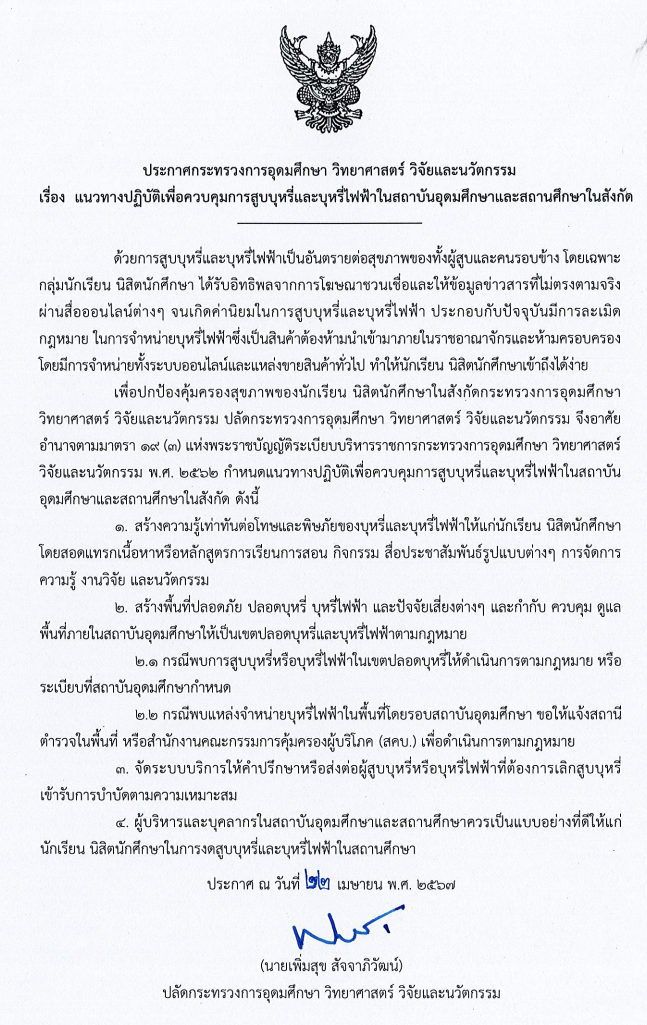
The policy framework includes four principal areas.
1.1 Tobacco Prevention and Awareness
Universities are encouraged to provide information concerning the health risks associated with tobacco products and electronic cigarettes.
Educational activities, student development programs, and health promotion campaigns can support greater understanding of the consequences of smoking and vaping.
1.2 Smoke-Free Educational Environments
Institutions are expected to comply with applicable legal requirements concerning smoking restrictions in educational facilities.
This includes identifying areas covered by smoking prohibitions, communicating restrictions, and implementing appropriate campus management measures.
1.3 Restrictions on Tobacco Promotion and Sales
The university’s policy framework emphasizes compliance with restrictions concerning tobacco promotion and sales in educational environments.
These measures are intended to reduce exposure to tobacco marketing and discourage tobacco use within university communities.
1.4 Cooperation and Implementation
The ministry’s guidance encourages educational institutions to cooperate with relevant public authorities and health organizations.
Such cooperation can support education, monitoring, prevention, and institutional compliance.
2. Legislative Framework Supporting Tobacco-Free Education
RMUTL’s smoke-free campus approach operates within Thailand’s national tobacco control framework.
The principal legislation includes the Tobacco Products Control Act B.E. 2560 (2017) and relevant subsidiary regulations governing tobacco control and smoke-free locations.
The legislative framework establishes restrictions intended to protect public health and limit exposure to tobacco smoke.
Educational institutions are required to comply with applicable restrictions concerning smoking in designated smoke-free areas and the sale or promotion of tobacco products.
Electronic cigarettes are also subject to relevant Thai legal restrictions.
For RMUTL, these requirements provide a legal foundation for communicating campus smoking restrictions, displaying appropriate signage, and organizing preventive education.
The university’s implementation activities must be interpreted in accordance with current laws and any applicable exceptions or designated-area requirements.
The reviewed public evidence does not establish the existence or location of approved designated smoking areas at every RMUTL campus.
Accordingly, the university’s policy direction should be distinguished from verified physical compliance at each individual facility.
3. Institutional Smoke-Free Campus Policy and Management Measures
RMUTL’s published institutional statement, “RMUTL Moves Toward a 100% Smoke-Free Campus in Line with MHESI Policy,” outlines its approach to tobacco prevention in the university environment.
The statement emphasizes the importance of protecting students, faculty members, personnel, and visitors from the risks of smoking and electronic cigarette use.
Its implementation directions include:
Smoke-Free and Vape-Free Areas: Promoting environments that comply with applicable smoking restrictions.
Health Education: Providing information about the harmful effects of tobacco products and vaping.
No-Smoking Signage: Communicating smoking restrictions through visible information and signs.
Institutional Oversight: Establishing responsibilities for monitoring and promoting compliance.
Public Health Cooperation: Working with relevant organizations to support tobacco prevention and health promotion.
The statement demonstrates the university’s institutional commitment to implementing national policy.
It provides a framework for practical activities, including student education, campus signage, and public health partnerships.
However, the statement was published in April 2024 and therefore serves as the existing policy foundation rather than a newly adopted policy during the 2025 reporting period.
4. Student-Led Tobacco and Alcohol Prevention through No-S No-L 2025
On June 29, 2025, RMUTL organized the 17th No-S No-L Student Engagement Program, emphasizing the principles of No Smoke and No Alcohol.
The event was organized by the Student Council and student associations in collaboration with the Student Development Division.
The activity received support from the Thai Health Promotion Foundation and the Upper Northern Thailand StopDrink Network.
More than 2,300 first-year students from four faculties and one college participated.
Student Participation and Health Awareness
The program combined student engagement with awareness of healthy behaviors.
Activities included:
- Orientation and engagement activities for new students.
- Introductions to academic programs and university services.
- Group activities promoting teamwork and social responsibility.
- Messages encouraging students to avoid smoking and alcohol.
- A welcoming ceremony and student pledge to avoid harmful substances.
The program used student participation and peer engagement as mechanisms for promoting healthy lifestyles.
Tobacco Prevention and Behavioral Awareness
The No-S No-L approach encourages students to recognize the risks associated with smoking and alcohol consumption.
By integrating health promotion into a large student orientation event, the university communicated prevention messages to a substantial number of new students.
The program also demonstrated cooperation among student organizations, university staff, and external health promotion partners.
Institutional Contribution
The event provided a visible opportunity to reinforce smoke-free values among incoming students.
Its documented outcomes include the implementation of the 17th annual program and participation by more than 2,300 first-year students.
These figures demonstrate the scale of student engagement.
However, participation in an awareness event should not be interpreted as proof that all participants stopped smoking or that campus smoking prevalence decreased.
Such outcomes would require surveys or follow-up assessment.
5. Smoke-Free Campus Development at Phitsanulok Campus
On August 1, 2025, RMUTL Phitsanulok Campus participated in a follow-up meeting under a project to develop higher education institutions free from smoking, electronic cigarettes, and tobacco products.
The meeting involved campus administrators, personnel, and students.
Representatives associated with the higher education smoke-free institution development initiative attended to review progress and discuss implementation.
Monitoring and Awareness Activities
The meeting provided an opportunity to consider the campus’s progress in implementing tobacco control measures.
The activity supported continued institutional engagement in smoke-free campus development.
The campus also received no-smoking signage to strengthen communication of tobacco restrictions.
Contribution to the Campus Environment
Visible no-smoking signs provide information to students, personnel, and visitors concerning smoking restrictions.
The receipt of signage also demonstrates a practical step toward strengthening campus implementation.
The activity complements tobacco prevention education by addressing the physical environment in which university members study and work.
Implementation Evidence and Limitations
The news confirms a monitoring meeting, institutional participation, and receipt of no-smoking signage.
It does not establish that every campus building was inspected or that all university facilities were verified as fully compliant.
Therefore, the documented outcome is progress in implementing and communicating smoke-free measures at Phitsanulok Campus.
6. Partnerships Supporting Tobacco Prevention
RMUTL’s smoke-free campus activities benefit from cooperation with external organizations working in public health and tobacco or alcohol prevention.
Thai Health Promotion Foundation
The Thai Health Promotion Foundation supported the 2025 No-S No-L student engagement program.
Its participation connected the university’s student activities with a national health promotion organization.
Upper Northern Thailand StopDrink Network
The network supported the prevention-focused student activity and contributed to wider cooperation concerning alcohol avoidance and healthy behaviors.
Higher Education Smoke-Free Development Network
The August 2025 Phitsanulok activity involved representatives of a higher education smoke-free institution development initiative.
This cooperation supported discussion, monitoring, and implementation of tobacco prevention measures.
Together, these relationships demonstrate how RMUTL connects university health promotion with wider public health networks.
They also provide opportunities to share educational materials and strengthen the implementation of tobacco prevention activities.
7. Institutional Implementation of Smoke-Free Measures
RMUTL’s activities can be understood through four interconnected approaches.
Policy Alignment
The university follows national tobacco control legislation and ministry guidance concerning smoking and electronic cigarettes in educational environments.
Education and Prevention
Student development activities promote awareness of tobacco-related health risks and encourage healthier behaviors.
Environmental Communication
No-smoking signs and other communications help convey smoking restrictions to university users and visitors.
Monitoring and Cooperation
Participation in smoke-free institution development activities provides opportunities to review progress and strengthen cooperation with relevant organizations.
Together, these approaches support the progressive implementation of smoke-free campus measures.
Evidence of full implementation across the entire university would require institution-wide records covering all campuses, facilities, signage, monitoring, enforcement arrangements, and any applicable designated smoking areas.
8. Institutional Contributions and Expected Impact
RMUTL’s tobacco prevention activities contribute to creating healthier environments for students, staff, and visitors.
Policy Compliance: Existing institutional guidance establishes the basis for complying with tobacco control legislation and ministry directions.
Student Awareness: The No-S No-L program reached more than 2,300 new students with messages supporting tobacco and alcohol avoidance.
Campus-Level Implementation: Phitsanulok Campus demonstrated action through smoke-free policy monitoring and the receipt of no-smoking signage.
External Cooperation: Partnerships with national and regional health promotion organizations supported preventive education and institutional engagement.
Health Protection: Smoke-free campus measures are intended to reduce exposure to tobacco smoke and support healthier learning and working environments.
The activities demonstrate progress in institutional awareness and implementation.
However, the reviewed sources do not provide campus-wide smoking prevalence data, enforcement statistics, air quality measurements, or verified reductions in tobacco use.
These indicators would help assess the long-term effectiveness of the university’s smoke-free initiatives.
9. Summary of Activities and Impacts
| Activity / Event | Promoted Theme | Stakeholders / Participants | Timeframe / The Impact |
|---|---|---|---|
| Institutional Smoke-Free Campus Policy Statement | National tobacco control compliance, smoke-free educational environments, and prevention of electronic cigarette use | RMUTL administration, personnel, students, and campus visitors | April 22, 2024 — Established a published institutional commitment and implementation direction; historical policy foundation |
| No-S No-L Student Engagement Program, 17th Edition | No Smoke, No Alcohol, student awareness, and healthy lifestyle promotion | RMUTL Student Council, student associations, Student Development Division, Thai Health Promotion Foundation, Upper Northern Thailand StopDrink Network, and first-year students | June 29, 2025 — More than 2,300 students participated in student-led health promotion and prevention activities |
| Smoke-Free Higher Education Institution Development Meeting, Phitsanulok | Tobacco prevention, electronic cigarette control, institutional monitoring, and smoke-free campus signage | RMUTL Phitsanulok administrators, staff, students, and smoke-free institution development representatives | August 1, 2025 — Reviewed campus implementation and received no-smoking signs to strengthen communication of tobacco restrictions |
| Continuing Campus Tobacco Prevention | Health education, awareness, compliance, and campus environmental management | RMUTL administrative and student development units | January 2025–March 2026 — Supported through documented awareness programs and campus-level activities; comprehensive university-wide compliance remains unverified |
10. Overall Institutional Impact
Between January 2025 and March 2026, RMUTL continued to implement tobacco prevention measures through student education, campus-level management, and public health partnerships.
The university’s activities were grounded in national tobacco control legislation and the policy direction established by MHESI.
The No-S No-L program provided a large-scale opportunity to promote smoke-free values among incoming students, while Phitsanulok Campus strengthened its participation in smoke-free institution development and received signage to communicate tobacco restrictions.
These activities demonstrate cooperation among university administrators, student organizations, public health partners, and campus personnel.
The documented achievements include the continuation of a student health promotion program, engagement with more than 2,300 first-year students, participation in a smoke-free institution development review, and provision of no-smoking signage.
RMUTL’s approach combines education, policy awareness, environmental communication, and institutional cooperation.
These efforts contribute to healthier educational environments and reinforce the importance of protecting university communities from tobacco-related risks.
Further institution-wide monitoring, accessible policy documentation, and systematic reporting would strengthen evidence that all campuses consistently implement smoke-free requirements.
Sources
- RMUTL Moves Toward a 100% Smoke-Free Campus in Line with MHESI Policy. April 22, 2024. Existing institutional policy foundation.
https://sdgs.rmutl.ac.th/3/smoke-free-campus/ - RMUTL Organizes the 17th No-S No-L Student Engagement Program to Promote Tobacco and Alcohol Prevention. June 29, 2025; published June 30, 2025.
https://rmutl.ac.th/news/29315 - RMUTL Phitsanulok Advances Smoke-Free Higher Education Development and Receives No-Smoking Signage. August 1, 2025.
https://www.rmutl.ac.th/news/29703 - Student Participation and Smoke-Free Campus Development Activities at RMUTL Phitsanulok. August 2025.
https://plc.rmutl.ac.th/edu/date/2025-08-01 - Tobacco Products Control Act B.E. 2560 (2017). National legal framework referenced in the RMUTL institutional policy statement.
https://sdgs.rmutl.ac.th/3/smoke-free-campus/