
Energy Efficiency Services for Industry
Rajamangala University of Technology Lanna (RMUTL) actively supports local industries in improving energy efficiency, reducing production costs, and advancing cleaner energy technologies through direct technical services, applied engineering research, professional training, and industrial technology assistance.
Between January 2025 and March 2026, the university implemented and supported industry-oriented initiatives involving energy-efficient manufacturing processes, electric vehicle charging technology, electricity generation systems, and industrial environmental management.
A significant achievement was the completion of an Industrial Technology Assistance Program (ITAP) project at P.N. Ceramic in Lampang Province on March 13, 2026. The project improved a ceramic drying oven through automated temperature and humidity control, industrial-grade sensors, and enhanced hot-air circulation.
The completed improvements were estimated to reduce electricity costs by 29%, equivalent to approximately THB 1,950 per month or THB 23,400 annually, assuming an average of 30 operating cycles per month.
RMUTL also strengthened industrial technical capacity through a DC Charger Technology workshop involving private-sector professionals and applied research with the Electricity Generating Authority of Thailand (EGAT) on energy generation and pollutant treatment technologies.
The university further supported regional small and medium-sized enterprises (SMEs) through ITAP, which provides access to technical experts, research services, technology development, and financial support mechanisms for eligible industrial improvement projects.
Together, these initiatives demonstrate RMUTL’s role in connecting engineering knowledge and research capabilities with practical industrial needs, supporting more efficient energy use, cleaner technologies, and improved industrial competitiveness.
1. Direct Industrial Energy Efficiency Services through ITAP
RMUTL provides technical assistance to local industries through its Strategic Projects Unit (SPU), which serves as a network implementation unit for the Industrial Technology Assistance Program (ITAP).
The program supports enterprises in applying research, engineering expertise, and technological innovations to improve production processes, reduce operating costs, and strengthen industrial competitiveness.
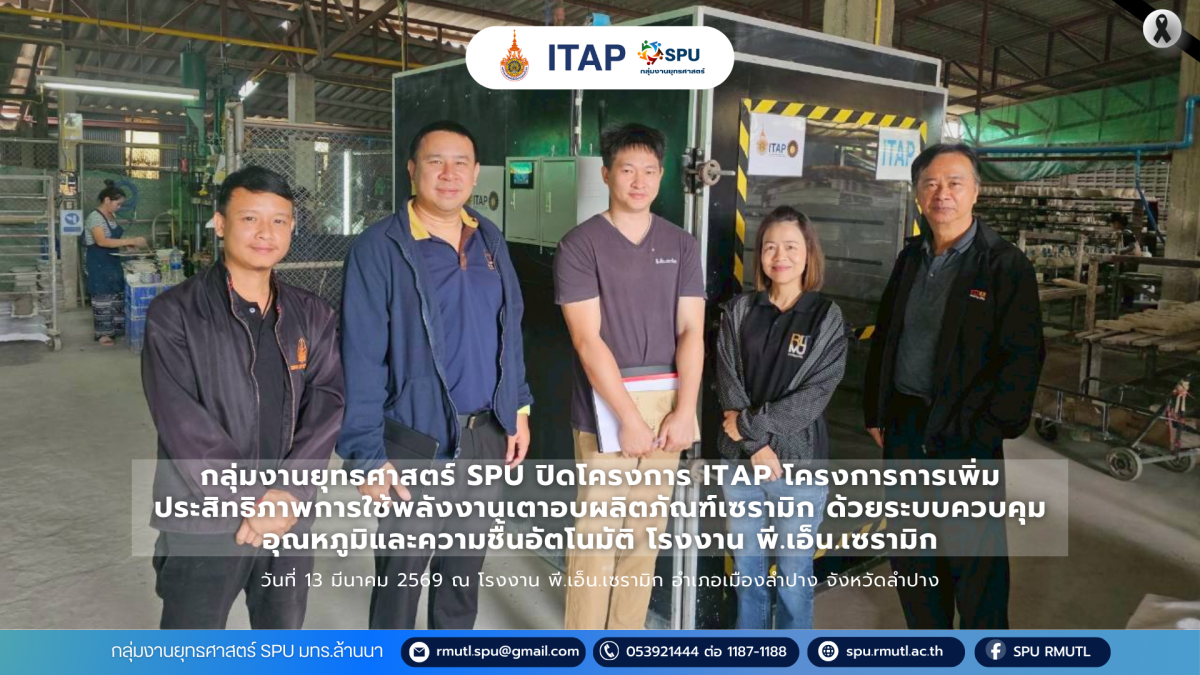
Energy Efficiency Improvement at P.N. Ceramic, Lampang Province
On March 13, 2026, RMUTL’s Strategic Projects Unit conducted the final evaluation of an ITAP project entitled “Improving Energy Efficiency in Ceramic Product Drying Ovens through Automated Temperature and Humidity Control” at P.N. Ceramic in Mueang Lampang District, Lampang Province.

The project addressed inefficient drying processes in ceramic manufacturing, where the control of temperature, humidity, and air circulation directly affects production time, electricity consumption, and product processing efficiency.
The objective was to improve the drying of unfired ceramic products by reducing unnecessary processing time and developing more effective oven operating conditions.
The research team was led by Assistant Professor Dr. Phakphum Charuphumi from RMUTL’s Industrial Engineering program, Faculty of Engineering, with research team members Wuttichai Soisena and Thanet Khanadee.
The team conducted production process assessments, analyzed energy consumption, developed control technologies, and evaluated system performance.

Technical Improvements and Energy Efficiency Measures
The research team implemented several improvements to the ceramic drying oven:
Industrial-Grade Temperature and Humidity Sensors: Existing sensors were replaced with higher-precision components suitable for industrial operating conditions.
Automated Process Control: A control system with a four-inch touchscreen interface was developed to improve temperature and humidity management.
Electrical System Improvements: The oven’s electrical wiring and control components were improved to support more reliable operation.
Hot-Air Circulation and Moisture Management: The internal circulation of hot air and moisture was improved to enhance drying efficiency and reduce unnecessary processing time.
These modifications aimed to improve the consistency of the drying process and reduce electricity consumption during production.

Measurable Industrial Energy Efficiency Outcomes
The project evaluation reported that the improved system could reduce electricity costs by approximately 29% under an assumed operating frequency of 30 drying cycles per month.
The estimated financial savings were:
- Monthly electricity cost savings: THB 1,950
- Annual electricity cost savings: THB 23,400
- Estimated electricity cost reduction: 29%
The reported savings demonstrate the potential economic benefits of applying automated control technologies to industrial production processes.
The project also supports more efficient manufacturing by improving the drying process and strengthening the enterprise’s capacity to manage production conditions.
An external expert from Chiang Mai University’s Faculty of Engineering participated in the project evaluation to review technical outcomes and provide recommendations for further improvement.
The completed project represents a concrete example of RMUTL delivering direct technical assistance to an industrial enterprise, with documented improvements and estimated energy cost savings.
The savings are based on the operating assumptions reported in the project evaluation. They should not be interpreted as verified annual electricity consumption reductions or quantified greenhouse gas emission reductions without additional measurement data.
2. Industrial Training and Technology Transfer in Electric Vehicle Charging Systems
RMUTL supports industrial adoption of clean energy technologies by providing specialized training and technical knowledge to professionals working in emerging energy-related sectors.
During February 3–4, 2025, RMUTL’s Research and Development Institute organized a DC Charger Technology workshop at the Modern Automotive Laboratory, Building C4, Doi Saket Campus, Chiang Mai Province.
The workshop was conducted under a research project focused on developing bidirectional charging technology for electric vehicles and power systems.
The activity involved RMUTL’s Clean Energy System Research Unit and private-sector partners, including KBM Technology Co., Ltd., and P.G. Intergroup.
Participants included academic personnel, students, and professionals from the electric vehicle industry.

Training Content and Industry Applications
The workshop introduced developments in electric vehicle charging infrastructure and the design of bidirectional charging systems.
Particular attention was given to Vehicle-to-Grid (V2G) applications, which allow electricity to flow between electric vehicles and electrical networks.
Participants examined how bidirectional charging technology can support improved energy management, including the potential use of electric vehicles as flexible energy resources.
The training also covered technical approaches to the design and development of bidirectional charging equipment and provided opportunities for exchanging experiences with industry specialists.
Through these activities, RMUTL provided technical knowledge relevant to future charging infrastructure development, energy system integration, and cleaner transportation technologies.
Contributions to Industrial Capacity Building
The workshop strengthened university–industry cooperation and provided professional development opportunities for personnel working in electric vehicle technology.
Its potential benefits include improved technical understanding of advanced charging systems, increased capacity for technology development, and opportunities for future industrial innovation.
The documented output was a technical training and knowledge exchange activity. The available evidence does not establish that participating companies subsequently installed the systems or achieved measurable energy savings as a direct result of the workshop.
3. Industry-Oriented Energy and Environmental Research with EGAT
RMUTL also contributes to cleaner industrial energy systems through technical assessments, research cooperation, and the development of technologies intended to address environmental challenges associated with electricity generation.
Technical Assessment at Mae Hong Son Diesel Power Plant
During October 13–14, 2025, RMUTL researchers conducted field investigations at the Mae Hong Son Diesel Power Plant and EGAT learning center in Mae Hong Son Province.
The activity involved three university research units:
- Clean Energy System Research Unit
- Applied Electric Field in Engineering Research Unit
- Environmental Research Unit
The fieldwork was conducted under a research project investigating pollutant removal from diesel electricity generators using biological capture and degradation processes involving microalgae.
The research teams collected technical data and environmental samples to support the development of pollution control technologies.
Energy System Assessment and Research Activities
Researchers collected exhaust particle samples from an 800-kilowatt diesel generator to establish baseline information for the design of a prototype exhaust filtration system.
The teams also examined relationships between electricity generation and exhaust emissions to support future improvements to combustion control and environmental performance.
Environmental researchers collected water samples from the plant’s air treatment and drainage systems, along with local microalgae samples, to investigate their potential use in biological pollutant treatment.
The research aimed to develop environmentally appropriate methods for reducing pollution associated with conventional electricity generation.
These activities demonstrate an industry-oriented technical assessment involving baseline measurements, environmental sampling, and the investigation of possible technological improvements.
Potential Benefits for Energy-Related Industries
The research provides technical information relevant to the development of pollution control and environmental management technologies for electricity generation facilities.
Potential applications include improvements in emissions treatment, more effective combustion-related environmental control, and biological wastewater treatment.
However, the field investigation was a research and assessment activity. The reviewed report does not confirm that the proposed filtration or biological treatment systems had been installed or achieved verified pollutant reductions.
The activity therefore demonstrates an early stage of technical service and applied research rather than a completed industrial energy efficiency intervention.
4. Research Cooperation for Cleaner Industrial Energy Technologies
On July 15, 2025, RMUTL welcomed representatives from EGAT’s Research and Innovation Division to the university’s Clean Energy System Research Unit and energy and environmental laboratories.
The visit provided opportunities to examine ongoing research and discuss potential collaboration in energy technology and environmental management.
The university presented research capabilities relevant to cleaner energy systems and pollutant treatment technologies, including research concerning the biological treatment of emissions from diesel generators.
The discussions strengthened cooperation between the university and a major national energy-sector organization.
In December 2025, RMUTL researchers also participated in EGAT’s annual research networking activities in Rayong Province, where they exchanged technical knowledge and presented progress in collaborative energy and environmental research.
These activities supported the development of research networks and opportunities for future technical cooperation.
Although such partnerships are not equivalent to completed industrial services, they contribute to the research infrastructure and technical relationships required to develop and deliver future energy-related solutions.
5. Institutional Mechanisms for Supporting Industrial Energy Efficiency
RMUTL strengthens access to industrial expertise through the Industrial Technology Assistance Program, which supports enterprises in applying technology and innovation to production and business development.
On December 1, 2025, RMUTL publicized the ITAP application process for fiscal year 2026, inviting eligible enterprises to submit technology and innovation development proposals.
The program covers several categories of industrial support, including:
Energy and Environmental Projects: Technical assistance addressing energy management, environmental performance, and related industrial challenges.
Machinery and Equipment Development: Research and development of machinery, tools, and production equipment that can improve industrial operations.
Production Efficiency Improvement: Assistance in developing more productive and efficient manufacturing processes.
Technical Consultation and Testing: Access to experts for analysis, technical evaluation, testing, and prototype development.
Technology and Innovation Support: Assistance in applying appropriate technologies to improve the competitiveness of regional enterprises.
Under the announced program conditions, eligible projects may receive financial support for up to 50% of approved project expenses, with a maximum contribution of THB 400,000 per project.
The program targets qualifying SMEs, including enterprises operating in regional industrial sectors.
This mechanism demonstrates how RMUTL helps connect industry with technical expertise, research resources, and structured assistance for industrial improvement.
The announcement establishes the availability of an industry support mechanism. It does not mean that all applicants received funding or that every supported project achieved energy savings.
Service Delivery and Financial Arrangements
RMUTL’s industry-related activities include training workshops, research cooperation, and project-based technical assistance.
The ITAP program operates under a cost-sharing support mechanism for eligible projects. However, the available public evidence does not establish the exact financial contribution paid by P.N. Ceramic or the fee arrangements for the DC Charger Technology workshop.
Accordingly, the activities can be described as industry assistance and technical services, while their individual classification as free or paid services requires confirmation from project agreements or financial records.
6. Institutional Contributions to Industrial Energy Efficiency and Clean Energy
RMUTL’s activities demonstrate four interconnected contributions to supporting energy efficiency and cleaner technology development in industry.
Direct Technical Assistance: Through the ITAP project at P.N. Ceramic, the university supported the development and implementation of automated process control technologies that improved industrial energy management and generated estimated electricity cost savings.
Professional Training and Technology Transfer: The DC Charger Technology workshop provided technical knowledge and professional development opportunities for private-sector participants involved in electric vehicle and energy technologies.
Technical Assessment and Applied Research: Field investigations at the Mae Hong Son Diesel Power Plant generated baseline technical and environmental information for developing pollutant reduction technologies.
Access to Industry Support Mechanisms: The ITAP program provides a structured approach for connecting SMEs with technical expertise, research services, technological improvements, and financial assistance for eligible projects.
These activities demonstrate how RMUTL supports industrial partners at different stages of technological development, from identifying production challenges and assessing technical conditions to implementing process improvements and transferring specialized knowledge.
The initiatives also strengthen cooperation among universities, public energy organizations, technology providers, and manufacturing enterprises.
7. Overall Contributions and Industrial Impact
Between January 2025 and March 2026, RMUTL demonstrated continued engagement in providing energy-related technical services and research support to industrial partners.
The most significant documented outcome was the completed improvement of the ceramic drying oven at P.N. Ceramic in Lampang Province, where automated control technologies were estimated to reduce electricity costs by 29% under the reported operating assumptions.
The university also supported industrial knowledge development through training in bidirectional EV charging and conducted technical research concerning pollution control at an electricity generation facility.
These activities were complemented by the ITAP program, which provides regional enterprises with opportunities to access technical assistance and support for innovation projects.
The documented contributions demonstrate the university’s ability to connect academic and engineering expertise with practical industrial challenges.
Potential longer-term benefits include more efficient manufacturing processes, reduced industrial energy costs, stronger technical competencies, improved environmental performance, and increased competitiveness among regional enterprises.
Continued evaluation of actual energy consumption, financial savings, technology adoption, and environmental outcomes will be important for measuring the broader impact of these services.
Through applied research, direct technical assistance, and industry-focused training, RMUTL contributes to the advancement of more energy-efficient and environmentally responsible industrial development.
8. Summary of Activities and Impacts
| Activity / Event | Promoted Theme | Stakeholders / Participants | Timeframe / The Impact |
|---|---|---|---|
| DC Charger Technology Workshop | Bidirectional EV charging, Vehicle-to-Grid technology, and industrial technical skills | RMUTL Research and Development Institute, Clean Energy System Research Unit, KBM Technology, P.G. Intergroup, and EV industry personnel | February 3–4, 2025 — Delivered technical training and knowledge exchange supporting cleaner transportation technology and industrial upskilling |
| EGAT Visit to RMUTL Clean Energy Research Facilities | Clean energy research, industrial energy systems, and environmental technology development | RMUTL researchers and EGAT Research and Innovation Division | July 15, 2025 — Strengthened technical cooperation and identified opportunities for collaborative energy research |
| Technical Assessment at Mae Hong Son Diesel Power Plant | Baseline emissions assessment, exhaust filtration research, and biological pollutant treatment | RMUTL’s three research units and EGAT-related energy facility personnel | October 13–14, 2025 — Collected samples and technical data from an 800-kW diesel generator to support pollution control research |
| ITAP Industry Assistance Program Announcement for FY2026 | Industrial energy efficiency, technology development, technical consultation, and SME innovation | RMUTL Strategic Projects Unit, ITAP network, eligible regional SMEs | December 1, 2025 — Publicized a support mechanism offering up to 50% of eligible project expenses, capped at THB 400,000 per project |
| EGAT Energy and Environmental Research Networking | Industrial environmental research and clean energy technology cooperation | RMUTL researchers, EGAT, and research partners | December 1–2, 2025 — Strengthened research cooperation and exchanged technical knowledge |
| ITAP Energy Efficiency Improvement Project at P.N. Ceramic, Lampang | Automated temperature and humidity control, improved drying processes, and industrial electricity efficiency | RMUTL Strategic Projects Unit, Industrial Engineering researchers, ITAP, P.N. Ceramic, and external technical evaluator | March 13, 2026 — Completed oven control improvements; estimated 29% reduction in electricity costs, equivalent to THB 1,950 per month or THB 23,400 annually at 30 operating cycles per month |
Sources
- RMUTL Organizes DC Charger Technology Workshop for EV Industry Professionals — February 3–4, 2025.
https://www.rmutl.ac.th/news/27975 - RMUTL Welcomes EGAT Representatives to Explore Clean Energy Research Cooperation — July 15, 2025.
https://www.rmutl.ac.th/news/29512 - RMUTL Research Units Conduct Technical Assessment at Mae Hong Son Diesel Power Plant — October 13–14, 2025.
https://engineering.rmutl.ac.th/news/30510 - RMUTL Central News: Research on Pollutant Treatment at Mae Hong Son Diesel Power Plant — October 2025.
https://www.rmutl.ac.th/news/30510-3 - ITAP Technology and Innovation Assistance Program: FY2026 Application Announcement — December 1, 2025.
https://www.rmutl.ac.th/news/31009-itap-2569 - RMUTL Researchers Participate in EGAT Energy and Environmental Research Networking — December 1–2, 2025.
https://www.rmutl.ac.th/news/31007 - RMUTL Strategic Projects Unit Completes ITAP Energy Efficiency Improvement Project at P.N. Ceramic, Lampang — March 13, 2026.
https://sdgs.rmutl.ac.th/7/กลุ่มงานยุทธศาสตร์-spu-ปิด-3/ - RMUTL Official News: ITAP Energy Efficiency Improvement at P.N. Ceramic — March 13, 2026.
https://www.rmutl.ac.th/news/32086