
Policy Development for Clean Energy Technology
Rajamangala University of Technology Lanna (RMUTL) strengthens its role in supporting government planning and policy development for clean energy and energy-efficient technologies through institutional strategies, applied research, technical assessments, and collaboration with public-sector organizations.
The university’s Five-Year Government Action Plan (2023–2027) establishes a strategic framework for research and innovation development, environmental responsibility, community partnerships, and the application of technologies to regional and national development challenges.
Under this framework, RMUTL identifies green energy systems as one of its areas of engineering expertise and promotes research collaboration among universities, government agencies, industry, and communities.
Between January 2025 and March 2026, RMUTL translated these strategic directions into activities through cooperation with the Electricity Generating Authority of Thailand (EGAT), the Royal Project Foundation, and public institutions.
Key contributions included:
- Establishing institutional research and partnership frameworks to support cleaner energy technologies and environmentally responsible development.
- Providing research-based technical information and expertise to EGAT through consultations and collaborative research activities.
- Conducting technical assessments of electricity generation and pollutant treatment systems at the Mae Hong Son Diesel Power Plant.
- Supporting joint research planning for appropriate energy and environmental technologies in highland communities.
- Participating in national energy research networks and exchanging information relevant to future energy development.
- Conducting field assessments of energy consumption, biomass management, and environmental challenges at Wat Chan Hospital and Royal Project Development Centers.
These activities demonstrate RMUTL’s contributions to the technical and research foundations of government energy planning at local, regional, and national levels.
The documented activities provide evidence of institutional strategies, government collaboration, research input, and technical assessment. Formal adoption of specific government energy policies based on RMUTL recommendations has not yet been established from the reviewed public sources.
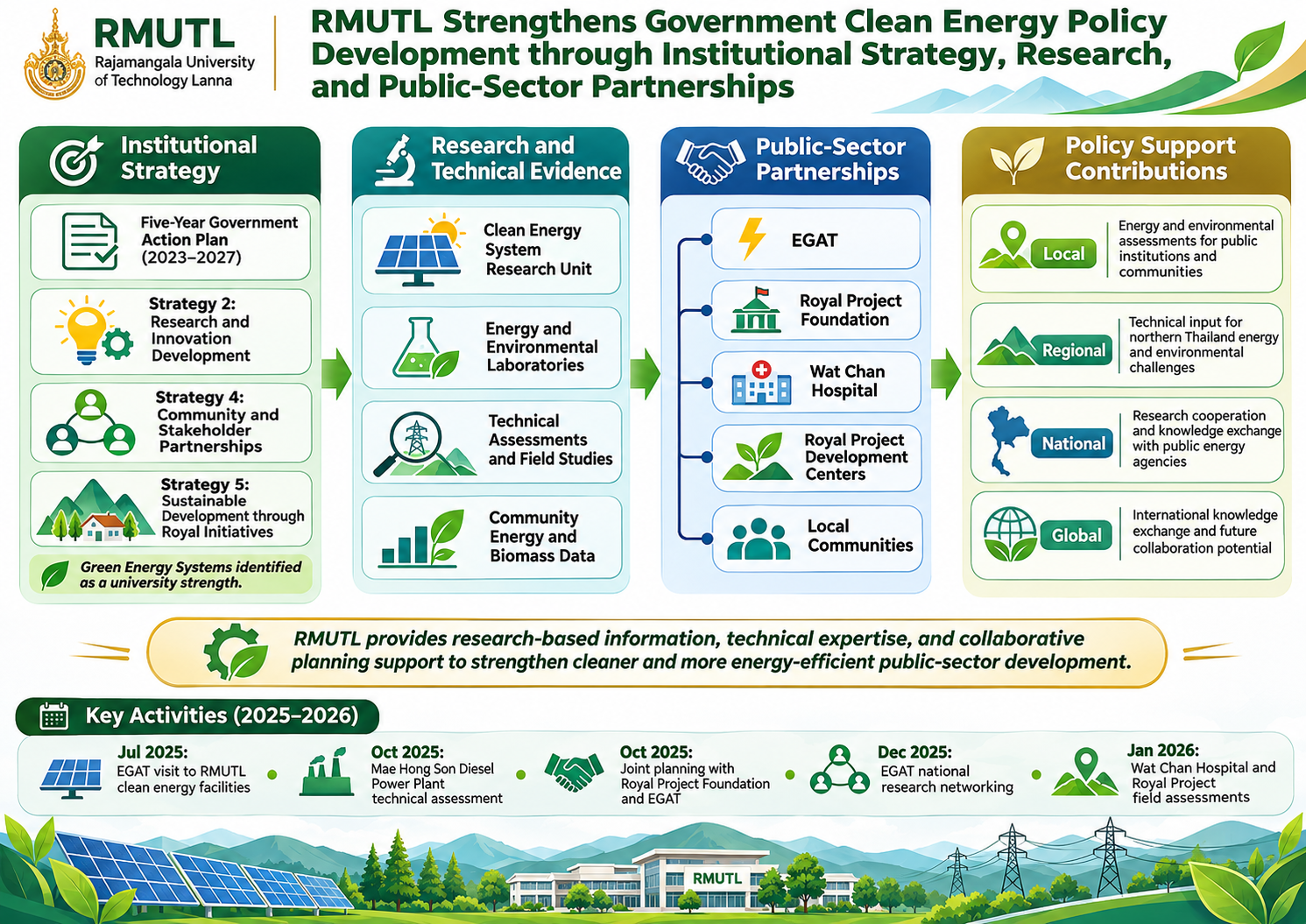
1. Institutional Strategic Framework for Government Clean Energy Collaboration
RMUTL’s support for public-sector energy and environmental development is grounded in its Five-Year Government Action Plan (2023–2027), which establishes the university’s institutional direction for education, research, innovation, organizational development, and community engagement.
The plan identifies engineering technology, including green energy systems, among the university’s areas of expertise.
It also emphasizes cooperation among higher education institutions, government agencies, industries, and communities to apply technology and innovation to economic, social, and environmental development.
Three institutional strategies are particularly relevant to RMUTL’s contributions to clean energy planning and technology development.
Strategy 2: Research and Innovation Development for Community and National Advancement
Strategy 2 promotes professional research and innovation development to generate technologies, inventions, and practical solutions that improve communities, society, and the country.
Its objectives include strengthening research and innovation management, enhancing professional and technological centers of excellence, and establishing collaborative research networks involving multiple sectors.
The strategy promotes the application of research and innovation in support of the Bio-Circular-Green (BCG) Economy Model, university–industry cooperation, local resource utilization, and technology-based development.
Relevant implementation mechanisms include:
- Strengthening research units, research centers, and centers of excellence.
- Establishing research networks and academic consortia at national and international levels.
- Developing research infrastructure and technical facilities.
- Supporting the utilization and transfer of research-based technologies.
- Strengthening collaborative mechanisms such as Talent Mobility and the Industrial Technology Assistance Program (ITAP).
These directions provide an institutional foundation for RMUTL researchers to contribute technical knowledge and evidence relevant to public-sector energy and technology planning.
The strategy supports the university’s capacity to undertake collaborative research with government energy agencies and examine technological solutions that respond to regional and national needs.
Strategy 4: Community and Stakeholder Partnerships for Environmentally Responsible Development
Strategy 4 focuses on strengthening partnerships, improving community capacity, and supporting environmentally responsible quality of life through technology and innovation.
The strategy emphasizes developing innovations that respond to local needs, establishing collaborative networks, and applying university knowledge to community and industrial development.
Its objectives include:
- Developing technologies and innovations that address challenges in local communities.
- Establishing partnerships with local organizations and development stakeholders.
- Applying research and innovation to strengthen local economies.
- Developing research and innovation networks involving multiple sectors.
- Supporting community and industrial development through university expertise.
The associated action programs include the development of external university service centers across six provinces and the establishment of practical models that communities and local enterprises can adapt.
This strategy provides a basis for RMUTL’s cooperation with local authorities, regional development organizations, and government energy agencies in identifying practical energy and environmental challenges.
It also supports the integration of technical research with local development planning.
Strategy 5: Sustainable Community Development through Royal Initiatives
Strategy 5 promotes the continuation and application of royal development principles through university knowledge, research, technology, and innovation.
The strategy supports community development by combining locally appropriate technologies with practical development approaches.
For energy-related initiatives, this direction is relevant to RMUTL’s collaboration with Royal Project Development Centers and government agencies in examining local energy needs, environmental conditions, and resource management challenges.
It provides an institutional foundation for research and technology transfer activities that support environmentally responsible development in highland communities.
Strategic Contributions to Public-Sector Energy Planning
Together, these strategies establish an institutional approach connecting research expertise, stakeholder cooperation, and community-oriented technology development.
They support RMUTL’s capacity to provide information and technical knowledge for government planning processes, including the assessment of energy challenges and consideration of possible technological interventions.
The Five-Year Government Action Plan is the university’s institutional strategic framework. It supports RMUTL’s role in public-sector cooperation but does not, by itself, establish that a specific government clean energy policy has been developed or adopted using university recommendations.
2. Strengthening Research Cooperation with National Government Energy Agencies
On July 15, 2025, RMUTL welcomed representatives from EGAT’s Research and Innovation Division to the university’s Clean Energy System Research Unit and energy and environmental laboratories at Doi Saket Campus, Chiang Mai Province.
The meeting brought together university researchers and public energy-sector personnel to exchange technical information, review ongoing research, and identify areas for future cooperation.
RMUTL presented research capabilities relevant to electricity generation, clean energy technologies, environmental management, and pollutant reduction.
The collaboration supported the exchange of research-based knowledge that may assist public energy organizations in examining existing technological challenges and considering future research priorities.
This activity demonstrates the implementation of RMUTL’s institutional strategy to strengthen research partnerships and apply academic expertise to national development challenges.
The documented contribution was technical consultation and research cooperation. The meeting did not, by itself, establish that a government energy policy had been adopted or revised.
3. Providing Technical Evidence for Regional Energy and Environmental Planning
During October 13–14, 2025, researchers from three RMUTL research units conducted technical investigations at the Mae Hong Son Diesel Power Plant.
The participating units included the Clean Energy System Research Unit, Applied Electric Field in Engineering Research Unit, and Environmental Research Unit.
The activities examined electricity generation operations, pollutant treatment systems, and opportunities for developing technologies that could reduce environmental impacts.
Researchers collected exhaust particle samples from an 800-kilowatt diesel generator and gathered environmental samples for research involving biological pollutant treatment and microalgae.
These investigations generated baseline technical information relevant to evaluating existing energy systems and developing possible improvements.
The technical work contributed to:
Identification of Energy and Environmental Challenges: Examining existing electricity generation processes and environmental impacts.
Research-Based Assessment: Collecting technical and environmental information to support the investigation of possible interventions.
Technology Development: Exploring approaches to improve pollutant treatment and environmental performance.
Support for Regional Planning: Providing a technical knowledge base relevant to future energy facility improvements and environmental management decisions.
The investigation demonstrates how university research can inform technical discussions concerning public energy infrastructure.
However, the reviewed evidence does not confirm that the findings were formally incorporated into an approved regional energy policy.
4. Integrating Government and Community Development through Collaborative Research Planning
On October 27, 2025, RMUTL participated in a strategic consultation involving the Royal Project Foundation and opportunities for cooperation with EGAT.
The meeting brought together representatives from RMUTL’s Community Technology Transfer Institute, Clean Energy System Research Unit, and development partners.
The discussions focused on identifying community development priorities, examining institutional research capabilities, and exploring opportunities for integrated research proposals.
This collaboration aligns with RMUTL’s Five-Year Government Action Plan, particularly its emphasis on multi-sector partnerships, community-oriented research, and the application of appropriate technologies.
For energy and environmental development, the collaboration provides opportunities to consider technologies that respond to local conditions and resource management needs.
The meeting established potential directions for future research cooperation and technical development.
Its documented outcome was collaborative planning rather than completion of a clean energy policy or installation of a new energy system.
5. Contributing to National Energy Research and Knowledge Exchange
During December 1–2, 2025, RMUTL researchers participated in EGAT’s annual government relations and research networking meeting in Rayong Province.
The meeting involved public energy-sector representatives, universities, and research networks.
Participants exchanged information concerning energy management, technological development, environmental research, and future energy-sector challenges.
RMUTL researchers presented progress in collaborative research on pollutant treatment for diesel electricity generation using microalgae-based biological processes.
The activity strengthened links between university research and the national energy sector.
It also supported the institutional objective of expanding research networks and improving the application of research to practical development challenges.
Through this engagement, RMUTL contributed research knowledge and technical perspectives relevant to national discussions on energy technology development.
The available evidence confirms participation in national research cooperation, but does not establish the adoption of specific policy recommendations submitted by the university.
6. Supporting Local Energy Planning through Joint Field Assessments
During January 20–22, 2026, RMUTL and EGAT conducted joint field assessments at Wat Chan Hospital in Galyani Vadhana District, Chiang Mai Province, and Royal Project Development Centers.
The university delegation included representatives from the Research and Development Institute, Clean Energy System Research Unit, Community Technology Transfer Institute, and Royal Initiative Project Working Group.
The EGAT delegation included personnel involved in energy management and related technical activities.
Energy and Environmental Assessment at Wat Chan Hospital
The teams met with hospital administrators to examine local energy and environmental challenges.
The discussions considered energy use, biomass management, open burning, air pollution, and community health.
The collaboration provided opportunities to identify practical problems and examine possible technical solutions.
The activity also supported the collection of information relevant to future planning by public institutions and energy-sector partners.
Energy and Resource Management at Royal Project Development Centers
The teams visited Nong Hoi and Mae Sa Mai Royal Project Development Centers to examine local energy and resource management conditions.
Field discussions provided information concerning operational requirements, environmental challenges, and opportunities for appropriate technology development.
The assessments supported the identification of local priorities and potential research directions.
These activities directly reflect RMUTL’s institutional strategy of connecting research and innovation with community development and environmentally responsible resource management.
Contributions to Government Planning
The field assessments generated information that could support future technical planning and the consideration of energy-related interventions in public institutions and highland communities.
They also strengthened collaboration among university researchers, a national government energy organization, healthcare personnel, and local development partners.
The documented outcome was the collection and exchange of technical information to support future planning.
Evidence of formal government policy adoption or implementation of proposed energy technologies would require additional documentation.
7. Institutional Mechanisms for Research-Based Policy Support
RMUTL’s Five-Year Government Action Plan provides a strategic framework linking research management, external partnerships, and community development.
The energy-related activities conducted during the reporting period demonstrate how this framework can be applied through several institutional mechanisms.
Research Expertise and Technical Infrastructure: University research units and laboratories provide expertise and facilities for investigating energy systems and environmental technologies.
Government and Industry Partnerships: Collaboration with EGAT and other organizations connects university research with practical challenges affecting energy infrastructure and public services.
Community-Based Problem Identification: Joint field assessments allow technical teams to gather information from local institutions and development partners before considering potential solutions.
Collaborative Research Planning: Multi-sector meetings support the identification of research priorities and the preparation of potential technical interventions.
Knowledge Exchange for Public-Sector Decisions: Research findings and technical assessments provide information that may support government planning, technology evaluation, and future policy discussions.
These mechanisms demonstrate RMUTL’s role in the technical and analytical stages of public-sector energy planning.
They also establish a foundation for more direct participation in government policy development when supported by documented policy consultations, formal technical recommendations, or official government requests for research input.
8. Contributions at Local, Regional, National, and International Levels
Local Level
RMUTL contributed technical expertise to joint assessments at Wat Chan Hospital and Royal Project Development Centers.
These activities generated information concerning local energy consumption, biomass management, environmental conditions, and potential technical interventions.
The work supports the development of evidence relevant to local planning and public service improvements.
Formal acceptance of recommendations by local government authorities remains to be verified.
Regional Level
Technical investigations at the Mae Hong Son Diesel Power Plant and research planning for highland communities addressed energy and environmental challenges relevant to northern Thailand.
These activities strengthened regional research cooperation and provided information that may inform future energy and environmental management.
The reviewed evidence does not establish that specific regional policies were revised as a result.
National Level
RMUTL’s cooperation with EGAT connects university research expertise with a national public energy organization.
Research consultations, technical investigations, and networking activities supported the exchange of information relevant to national energy-sector challenges.
These activities demonstrate national-level technical cooperation and research engagement, although direct participation in the adoption of a specific national energy policy has not been verified.
International Level
RMUTL’s strategic plan supports national and international research networks and the international development of university expertise.
These directions may strengthen the institution’s capacity to exchange knowledge and examine international energy-related practices.
However, the reviewed evidence does not establish direct contributions to energy policy development by foreign governments or international intergovernmental organizations during the reporting period.
9. Summary of Activities and Impacts
| Activity / Event | Promoted Theme | Stakeholders / Participants | Timeframe / The Impact |
|---|---|---|---|
| RMUTL Five-Year Government Action Plan (2023–2027) | Research and innovation, green energy expertise, stakeholder partnerships, and environmentally responsible development | RMUTL administration, research units, academic departments, and external stakeholders | 2023–2027 — Established an institutional strategic framework for research cooperation, technology development, and community-oriented innovation |
| Strategy 2: Research and Innovation Development | Multi-sector research networks, research infrastructure, and technology utilization | RMUTL researchers, research centers, government agencies, industry partners, and communities | 2023–2027 — Provides strategic support for research-based technical contributions to national and regional development |
| Strategy 4: Community and Stakeholder Partnerships | Environmentally responsible community development, local innovation, and external cooperation | RMUTL campuses, local organizations, communities, and industry networks | 2023–2027 — Establishes institutional directions for applying university expertise to local and regional challenges |
| Strategy 5: Sustainable Development through Royal Initiatives | Appropriate technology and community development | RMUTL, Royal Project-related organizations, and local communities | 2023–2027 — Supports the application of university knowledge to sustainable community development |
| EGAT Visit to RMUTL Clean Energy Research Facilities | Clean energy research and public-sector technical cooperation | RMUTL Clean Energy System Research Unit and EGAT Research and Innovation Division | July 15, 2025 — Strengthened research consultation and future technology development opportunities |
| Mae Hong Son Diesel Power Plant Technical Assessment | Electricity generation, environmental monitoring, and pollutant treatment | RMUTL research units and energy facility personnel | October 13–14, 2025 — Generated baseline technical and environmental information relevant to future energy facility improvements |
| Integrated Research Planning with the Royal Project Foundation and EGAT | Community-oriented technology development and collaborative research planning | RMUTL, Royal Project Foundation, and EGAT | October 27, 2025 — Identified research cooperation opportunities and potential technological solutions for highland communities |
| EGAT Annual Research Networking Meeting | National energy research cooperation and environmental technology development | RMUTL researchers, EGAT, universities, and research networks | December 1–2, 2025 — Supported national knowledge exchange and collaborative research development |
| Wat Chan Hospital Energy and Environmental Assessment | Local energy challenges, biomass management, and environmental planning | RMUTL, EGAT, and hospital administrators | January 20–22, 2026 — Identified local energy and environmental needs for potential technical planning |
| Royal Project Development Center Field Assessments | Appropriate energy technologies and sustainable resource management | RMUTL, EGAT, Nong Hoi and Mae Sa Mai Royal Project Development Centers | January 20–22, 2026 — Gathered information relevant to future energy and environmental improvement projects |
10. Overall Institutional Contributions and Impact
RMUTL’s activities during January 2025–March 2026 demonstrate the practical application of its Five-Year Government Action Plan through cooperation with public energy organizations, research institutions, and community development partners.
The university’s strategic framework emphasizes research and innovation, environmental responsibility, stakeholder partnerships, and the application of technologies to address community and national development challenges.
Within this framework, RMUTL strengthened technical cooperation with EGAT, conducted assessments of energy and environmental systems, participated in national research networks, and examined energy-related challenges affecting public institutions and highland communities.
These activities contributed to the identification of practical problems, the generation of research-based information, and the examination of potential technological interventions.
The university’s institutional role can therefore be characterized as providing technical expertise, research evidence, and collaborative planning support that may inform government energy-related decisions.
The documented achievements establish a connection between university strategic planning and public-sector technical cooperation.
The anticipated benefits include stronger government–university research partnerships, improved understanding of regional energy challenges, more appropriate technology development, and opportunities for evidence-informed clean energy planning.
Further documentation of policy recommendations, government consultations, and the incorporation of RMUTL research into official energy plans would strengthen evidence of direct policy development contributions.
Through its institutional strategies and continued public-sector partnerships, RMUTL supports the development of technical knowledge and collaborative mechanisms needed for cleaner and more efficient energy systems.
Sources
- RMUTL Five-Year Government Action Plan (2023–2027) — Institutional Strategic Framework, particularly Strategies 2, 4, and 5.
Official Five-Year Government Action Plan (PDF) - RMUTL Welcomes EGAT Representatives to Explore Clean Energy Research Cooperation — July 15, 2025.
https://www.rmutl.ac.th/news/29512 - RMUTL Research Units Conduct Technical Assessments at Mae Hong Son Diesel Power Plant — October 13–14, 2025.
https://engineering.rmutl.ac.th/news/30510 - RMUTL and Royal Project Foundation Advance Integrated Research Cooperation with EGAT — October 27, 2025.
https://www.rmutl.ac.th/news/30631 - RMUTL Researchers Participate in EGAT Energy and Environmental Research Networking — December 1–2, 2025.
https://www.rmutl.ac.th/news/31007 - RMUTL and EGAT Conduct Energy and Environmental Field Assessments at Wat Chan Hospital and Royal Project Development Centers — January 20–22, 2026.
https://www.rmutl.ac.th/news/31534-23169 - RMUTL Discusses Integrated Community Development with Mae Sa Mai Royal Project Development Center — January 2026.
https://www.rmutl.ac.th/news/31402