
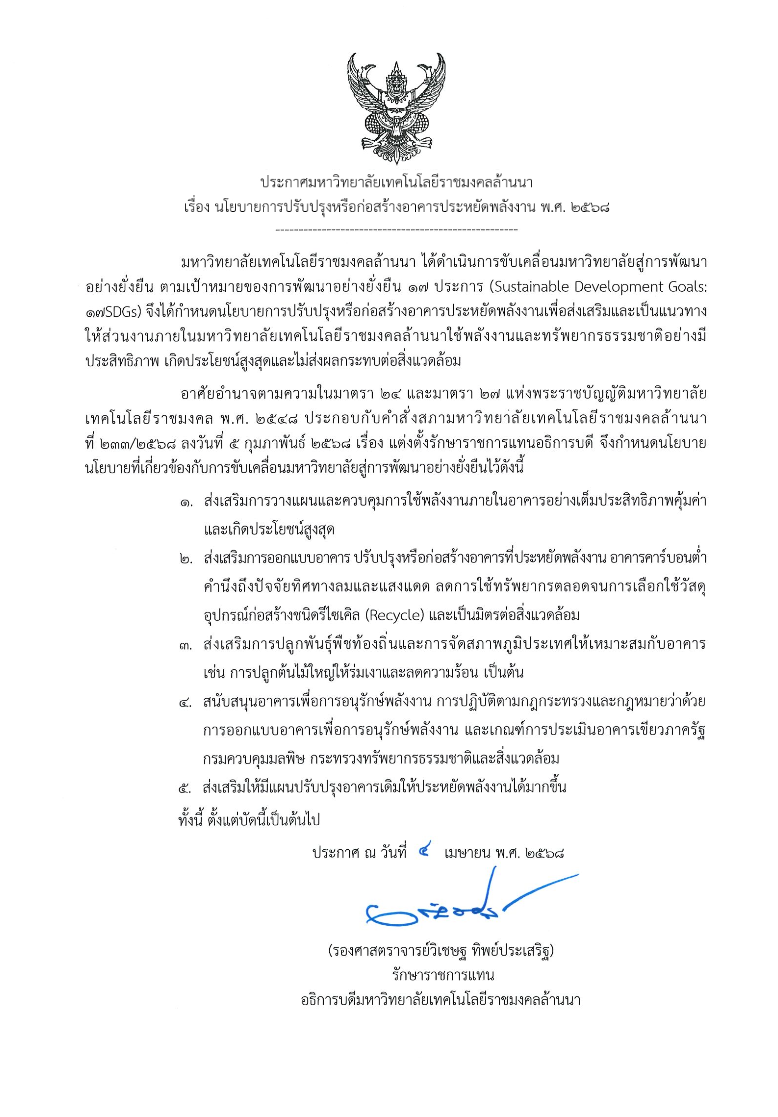
Rajamangala University of Technology Lanna (RMUTL) formally adopted the Building Renovation and Energy Conservation Construction Policy (B.E. 2568/2025) in April 2025, establishing a university-wide framework to ensure that energy efficiency, responsible resource use, and environmental sustainability are integrated into all new construction, renovation, and refurbishment projects.
The policy was signed by Associate Professor Wichet Thipprasert, Acting President of RMUTL, and applies to all university campuses. It outlines five key measures covering energy-efficient building planning and operation, environmentally responsible construction materials, green space development, compliance with relevant government guidance, and continuous improvements in renovation practices.
The policy also promotes cooperation with municipal authorities and relevant government agencies to support environmentally responsible, socially inclusive, and climate-resilient campus development.
Together with existing campus energy conservation measures, the policy provides a formal institutional foundation for improving building energy performance, reducing unnecessary energy consumption, and strengthening the university’s long-term environmental management.
1. Establishment of the University-Wide Energy-Efficient Building Policy
In April 2025, RMUTL issued the Building Renovation and Energy Conservation Construction Policy (B.E. 2568/2025), formally titled in Thai:
ประกาศมหาวิทยาลัยเทคโนโลยีราชมงคลล้านนา เรื่อง นโยบายการปรับปรุงหรือก่อสร้างอาคารประหยัดพลังงาน พ.ศ. 2568
The policy establishes requirements and guidance for incorporating energy conservation and environmental responsibility into university infrastructure development.
Policy Information
- Policy Title: Building Renovation and Energy Conservation Construction Policy (B.E. 2568/2025)
- Date: April 2025
- Authorized Signatory: Associate Professor Wichet Thipprasert, Acting President, RMUTL
- Policy Coverage: All RMUTL campuses
- Applicable Activities: New building construction, renovation, refurbishment, and related building improvement activities
The policy was established to promote efficient energy and natural resource use, minimize environmental impacts associated with university infrastructure, and strengthen institutional practices for sustainable campus development.
By introducing a common university-wide policy, RMUTL aims to ensure that energy efficiency is considered throughout building planning, renovation, construction, and operation.
2. Main Policy Measures for Energy-Efficient Construction and Renovation
The policy establishes five principal measures to guide responsible infrastructure development across RMUTL campuses.
2.1 Energy-Efficient Planning and Building Operations
RMUTL promotes systematic planning and efficient energy use throughout building operations to maximize the benefits of energy resources.
The policy encourages university units responsible for infrastructure and facility management to consider energy efficiency during building planning, design, renovation, and operation.
This approach supports the selection of appropriate building systems, improved operational practices, and more effective management of electricity consumption.
Integrating energy conservation considerations from the planning stage can help reduce unnecessary energy demand and contribute to more efficient long-term building operations.
2.2 Environmentally Responsible Construction Materials and Techniques
The policy encourages the use of renewable or recycled construction materials and environmentally friendly construction techniques where appropriate.
This measure promotes consideration of material efficiency, responsible resource consumption, and environmental impacts during construction and renovation.
By encouraging resource-conscious construction practices, the university seeks to reduce the environmental burden associated with infrastructure development while supporting more sustainable use of natural materials.
2.3 Green Space Development and Carbon Absorption
RMUTL promotes tree planting and green space development across university campuses to reduce heat accumulation and support the absorption of carbon dioxide.
Green areas can contribute to more comfortable outdoor environments, improve campus environmental conditions, and help reduce heat exposure around buildings.
This measure connects energy-efficient infrastructure development with broader environmental management and the improvement of campus landscapes.
It also encourages the integration of natural features into university development planning.
2.4 Alignment with Government Energy and Environmental Guidelines
The policy supports building designs that follow relevant guidance from Thailand’s Ministry of Energy and Ministry of Natural Resources and Environment.
This measure emphasizes the importance of considering applicable national guidance when planning and implementing construction and renovation projects.
It provides an institutional basis for aligning university infrastructure decisions with recognized energy conservation and environmental management practices.
The policy also encourages responsible units to consider appropriate technical standards and government recommendations when developing building improvement projects.
2.5 Continuous Improvement of Building Renovation Practices
RMUTL encourages continuous review and improvement of building renovation methods to enhance energy efficiency over time.
This measure recognizes that energy-efficient building management requires ongoing attention to changing technologies, building conditions, and operational requirements.
The university’s approach supports opportunities to review existing practices, identify improvements, and incorporate more efficient technologies or construction approaches into future projects.
Continuous improvement also provides a foundation for monitoring building performance and strengthening institutional energy management.
3. Institutional Commitment and Cooperation with Government Agencies
In addition to the five policy measures, RMUTL commits to strengthening cooperation with municipal authorities and relevant government departments to support environmentally responsible university development.
This commitment emphasizes the integration of institutional infrastructure planning with broader environmental, social, and long-term development considerations.
Cooperation with public authorities can support the exchange of technical information, alignment with relevant government guidance, and consideration of environmental impacts in university construction and renovation activities.
Through this approach, RMUTL seeks to ensure that campus infrastructure development is consistent with responsible resource management and contributes to long-term environmental sustainability.
4. Continuity of Campus-Level Energy Conservation Measures
The 2025 university-wide policy builds upon earlier energy conservation initiatives undertaken at individual RMUTL campuses.
On March 28, 2024, RMUTL Chiang Rai Campus issued a formal Energy Conservation Policy in accordance with Thailand’s requirements for designated government buildings subject to energy management obligations.
The campus also introduced Energy Efficiency Measures in 2024, covering practical approaches to reducing electricity consumption and improving building operations.
These measures included:
- Maintaining air-conditioning temperature settings at 25°C to support more efficient cooling.
- Promoting appropriate schedules for lighting and electrical equipment operation.
- Introducing smart electrical control technologies to improve equipment management.
- Encouraging the responsible operation and maintenance of building systems.
Although these activities preceded the 2025 reporting period, they demonstrate that RMUTL had already established operational experience in managing building energy consumption.
The adoption of the university-wide policy in April 2025 represents an important step toward strengthening and harmonizing energy conservation expectations across all campuses.
5. Supporting Technical Capacity for Energy-Efficient Infrastructure
RMUTL has also promoted technical knowledge relevant to energy-efficient and clean energy infrastructure.
During March 6–8, 2024, RMUTL Chiang Mai organized educational workshops on electric vehicle charging station technology.
The workshops supported knowledge development and technical awareness of electric vehicle charging systems and related clean energy infrastructure.
While these activities were conducted before the current reporting period, they provide additional institutional context concerning the university’s technical capabilities and interest in energy-efficient infrastructure development.
Together, building energy conservation measures and technical learning activities provide a foundation for future integration of efficient electrical systems and cleaner energy technologies into university facilities.
6. Institutional Contributions and Expected Impact
The adoption of the Building Renovation and Energy Conservation Construction Policy in April 2025 represents an institutional commitment to improving energy performance and environmental responsibility in university infrastructure development.
The policy makes several important contributions.
University-Wide Policy Coverage: It establishes a common institutional framework covering new construction, renovation, and refurbishment across all RMUTL campuses.
Energy Efficiency Integration: It promotes consideration of energy efficiency throughout building planning, design, operation, and future improvements.
Environmental Resource Management: It encourages responsible construction materials, green spaces, and environmentally appropriate building techniques.
Alignment with Government Guidance: It supports the use of relevant national energy and environmental guidance and cooperation with municipal and government authorities.
Continuous Institutional Improvement: It establishes expectations for the ongoing review and improvement of renovation and building management practices.
The anticipated benefits include more efficient energy consumption, improved building operational performance, reduced environmental impacts, and more sustainable infrastructure management.
The policy provides the formal institutional framework for these improvements. Additional building-level evidence, including construction specifications, renovation plans, energy assessments, and post-implementation performance data, would be needed to quantify the benefits achieved.
7. Summary of Activities and Impacts
| Activity / Event | Promoted Theme | Stakeholders / Participants | Timeframe / The Impact |
|---|---|---|---|
| Adoption of the Building Renovation and Energy Conservation Construction Policy (B.E. 2568/2025) | University-wide energy-efficient construction and renovation policy | RMUTL administration, all campuses, infrastructure and facility management units | April 2025 — Established a formal policy framework covering new construction, renovation, and refurbishment |
| Energy-Efficient Building Planning and Operations | Efficient energy use throughout building planning and operation | Campus administrators, facility managers, building design and maintenance personnel | From April 2025 — Established institutional guidance for incorporating energy efficiency into infrastructure decisions |
| Environmentally Responsible Construction Materials | Renewable and recycled materials, resource-efficient construction techniques | RMUTL infrastructure units, project planners, and construction stakeholders | From April 2025 — Promoted environmentally responsible material selection and construction practices |
| Tree Planting and Green Space Development | Heat reduction, carbon absorption, and campus environmental management | RMUTL campuses, landscape and infrastructure management units | From April 2025 — Established policy guidance supporting green space development and improved campus environmental conditions |
| Alignment with Government Energy and Environmental Guidelines | Energy-efficient building design and responsible infrastructure development | RMUTL, relevant government departments, municipal authorities | From April 2025 — Provided a framework for aligning infrastructure planning with government energy and environmental guidance |
| Continuous Improvement of Building Renovation Practices | Long-term building energy efficiency and maintenance improvement | Infrastructure units, building managers, and maintenance personnel | From April 2025 — Encouraged ongoing improvement of renovation and building management practices |
| Chiang Rai Campus Energy Conservation Policy and Operational Measures | Air-conditioning control at 25°C, lighting schedules, and smart electrical management | RMUTL Chiang Rai Campus administration and building users | March 2024 — Earlier campus-level measures demonstrating institutional continuity; not counted as new 2025 activities |
| EV Charging Station Technology Workshops, Chiang Mai | Technical capacity for clean energy and energy-efficient infrastructure | RMUTL academic staff, engineering specialists, and workshop participants | March 6–8, 2024 — Earlier technical capacity-building activity supporting knowledge of clean energy infrastructure |
8. Overall Institutional Impact
RMUTL’s adoption of the Building Renovation and Energy Conservation Construction Policy in April 2025 marked an important development in formalizing energy efficiency expectations across the university.
The policy provides a consistent framework for incorporating energy conservation, environmentally responsible construction, green space development, and continuous improvement into infrastructure planning and management.
By applying the policy to all RMUTL campuses, the university establishes shared expectations for new building projects and renovations while supporting alignment with relevant government energy and environmental guidance.
The policy also builds upon earlier campus-level energy conservation measures, demonstrating continuity between operational energy management and institutional infrastructure planning.
Together, these efforts strengthen RMUTL’s capacity to pursue more efficient, environmentally responsible, and resilient campus infrastructure development.
The documented institutional outcome is the adoption of the policy. Its long-term benefits will depend on implementation in construction and renovation projects, continued monitoring, and the evaluation of building energy performance.
Sources
- RMUTL Official Announcement: Building Renovation and Energy Conservation Construction Policy (B.E. 2568/2025) — April 2025. Signed by Associate Professor Wichet Thipprasert, Acting President, RMUTL.
https://sdgs.rmutl.ac.th/7/7-2-1policybuilding-renovation-and-energy-conservation-construction/ - Official Policy Announcement Image
https://sdgs.rmutl.ac.th/wp-content/uploads/2025/11/Screenshot-2568-11-09-at-12.54.30.png - RMUTL Chiang Rai Energy Conservation Policy and Energy Efficiency Measures (2024) — Earlier institutional policy and operational measures, referenced in the official policy report.
https://sdgs.rmutl.ac.th/7/7-2-1policybuilding-renovation-and-energy-conservation-construction/ - RMUTL Chiang Mai: EV Charging Station Technology Workshops (March 6–8, 2024) — Earlier technical capacity-building activity, referenced in the official policy report.
https://sdgs.rmutl.ac.th/7/7-2-1policybuilding-renovation-and-energy-conservation-construction/