
Assistance to Low-Carbon Innovation
Rajamangala University of Technology Lanna (RMUTL) supports the development of environmentally responsible startups and emerging technology ventures through entrepreneurship education, business incubation, prototype development, technical research, and collaboration with financial institutions and industry partners.
Between January 2025 and March 2026, the university strengthened its support for early-stage entrepreneurs through its University Business Incubator (UBI), the GSB Micropreneur Academy, engineering research units, and industrial technology assistance networks.
A significant achievement was the GSB Smart Start Idea 2025 program, organized in collaboration with the Government Savings Bank. The initiative supported students and recent graduates in developing environmentally friendly business concepts and prototypes with potential for commercial development.
Participants were offered business development opportunities, including a Green Business Canvas and Storytelling Bootcamp, expert guidance, entrepreneurial skills development, prototype presentations, and competitive selection.
Three teams received university-level awards, including two projects with particular relevance to resource efficiency and circular economy innovation:
- Relic the Memory Toy: Development of three-dimensional printed art toys using material derived from discarded plastic bottles.
- EGGLAZE: Development of a ceramic glaze product using eggshell waste as an alternative material.
The university also supported the wider clean technology ecosystem through electric vehicle charging technology training, research partnerships, and the Industrial Technology Assistance Program (ITAP), which connects eligible SMEs with technical experts and innovation support.
These activities demonstrate a structured approach to assisting emerging entrepreneurs and supporting technologies that can contribute to a resource-efficient and lower-carbon economy.
The documented achievements include entrepreneurial training, prototype development support, university-level recognition, access to national startup competition opportunities, and industry-oriented technology assistance. Verified greenhouse gas reductions, formal incorporation of the student ventures, and their commercial performance remain to be established.
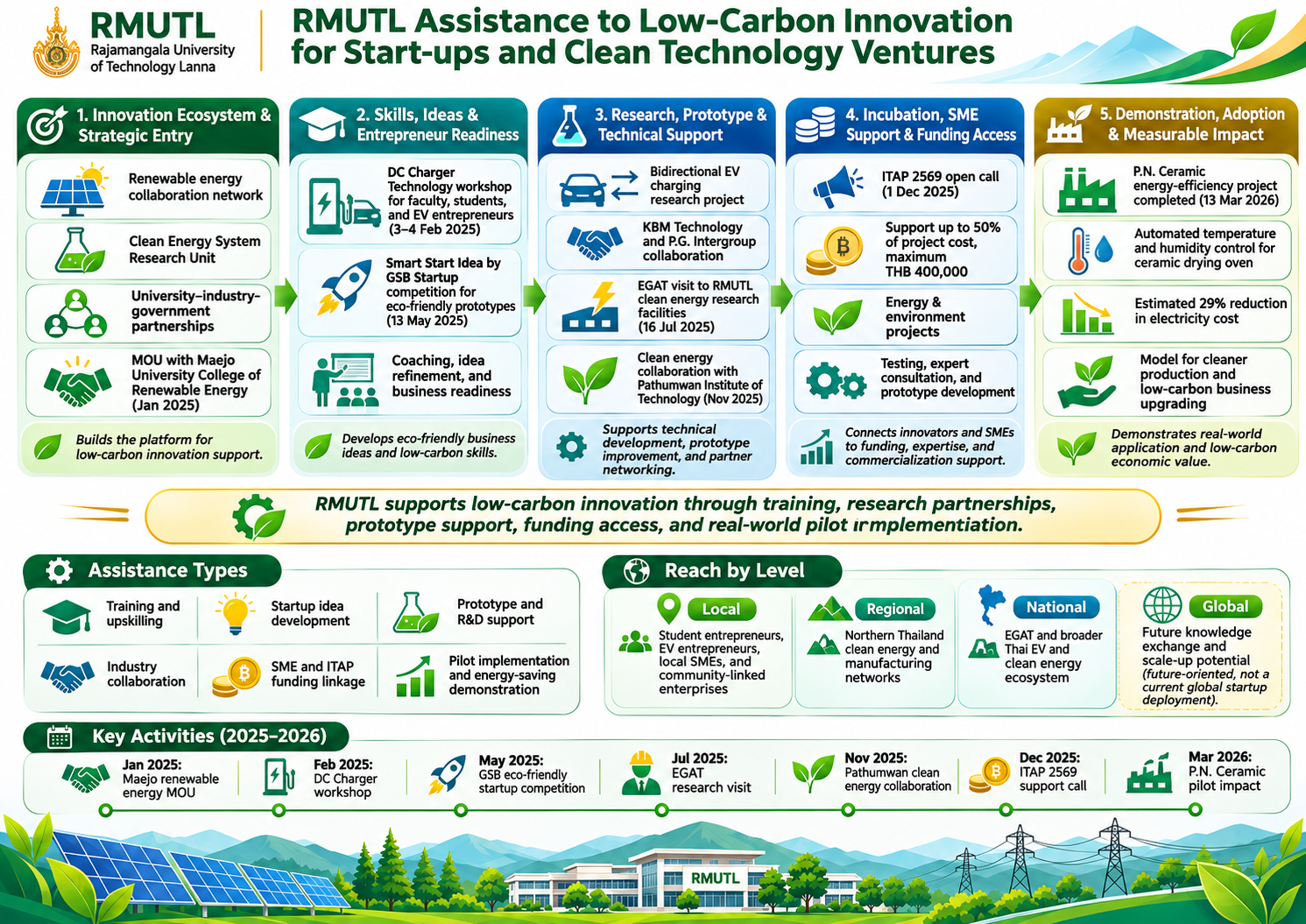
1. Institutional Strategy for Green Entrepreneurship and Low-Carbon Innovation
RMUTL’s Five-Year Government Action Plan (20232027) establishes an institutional framework for research and innovation development, entrepreneurship, community partnerships, and the practical application of technology.
The university’s strategic directions emphasize developing research capabilities, strengthening cooperation with external organizations, and supporting the transfer and utilization of technologies that respond to economic and environmental challenges.
These priorities provide a foundation for assisting entrepreneurs whose products, services, or technologies contribute to cleaner production, more efficient resource use, and environmentally responsible business practices.
RMUTL implements this approach through complementary mechanisms.
University Business Incubator: Supports students, recent graduates, and emerging entrepreneurs in developing business ideas, strengthening entrepreneurial competencies, and preparing prototypes for potential commercialization.
Research and Engineering Units: Provide technical expertise, research capabilities, laboratories, and opportunities for the development of clean energy and resource-efficient technologies.
UniversityIndustry Partnerships: Connect academic knowledge with technology enterprises and industry specialists to support applied research and product development.
Innovation and Technology Assistance: Facilitate access to technical consultation, testing, prototype development, and eligible industrial innovation support programs.
Together, these mechanisms establish a pathway through which early-stage business ideas and research-based innovations can progress toward practical applications and possible commercial development.
2. Green Startup Incubation through the GSB Micropreneur Academy
During 2025, RMUTL’s University Business Incubator collaborated with the Government Savings Bank to implement the GSB Smart Start Idea initiative under the GSB Micropreneur Academy.
The program targeted RMUTL students and graduates who had completed their studies within the previous five years.
Its purpose was to encourage participants to transform creative ideas and prototypes into commercially viable products or services while incorporating environmentally responsible business practices.
The university adopted the theme “Eco-Friendly Business”, encouraging applicants to consider environmental responsibility alongside innovation and market potential.
The initiative provided opportunities for participants to strengthen their entrepreneurial capabilities, develop products, and prepare for future business establishment.
Rather than focusing solely on conventional business ideas, the program encouraged participants to explore the relationship between product development, material selection, resource efficiency, and business sustainability.
Assistance Provided to Emerging Entrepreneurs
The program supported entrepreneurship development through several mechanisms:
Business Idea Development: Encouraging participants to identify market opportunities and develop product or service concepts.
Prototype-Oriented Innovation: Supporting the presentation and evaluation of products with potential for business development.
Business Skills Development: Providing learning opportunities relevant to business planning, entrepreneurial decision-making, and market readiness.
Expert Evaluation and Guidance: Involving university specialists in assessing project proposals and providing feedback.
Startup Competition Opportunities: Selecting promising teams to represent the university in a subsequent national competition.
These activities provide evidence of direct assistance to early-stage entrepreneurs, particularly through business preparation, prototype presentation, and access to development opportunities.
3. Green Business Canvas and Storytelling Bootcamp
RMUTL’s University Business Incubator announced the RMUTL Business Bootcamp: Green Business Canvas & Storytelling, scheduled for April 2930, 2025, at the Center for Innovation and Technology Management (CiNT), Chiang Mai Campus.
The program was designed to strengthen participants’ ability to develop environmentally responsible business models and communicate the value of their innovations.
The announced program included two principal components.
Green Business Canvas
This component focused on developing business models that incorporate environmental responsibility and long-term sustainability.
Participants were introduced to approaches for considering the relationship between business activities, customer needs, resource utilization, and environmental value.
For ventures developing circular economy products or cleaner technologies, business model development can help clarify how environmental benefits relate to product value and commercial feasibility.
Business Storytelling and Communication
This component focused on helping entrepreneurs communicate their products and business concepts to potential customers, partners, and other stakeholders.
Effective communication is particularly important for emerging innovations whose environmental or technical benefits may require explanation to prospective users.
The bootcamp announcement offered training opportunities to applicants participating in the Smart Start Idea competition.
The initiative demonstrates the university’s provision of structured entrepreneurial development opportunities. The public announcement establishes the planned training content and eligibility, while subsequent competition reports confirm that participating students received business preparation support.

4. Supporting Circular Economy Startup Concepts and Prototypes
On May 14, 2025, RMUTL’s University Business Incubator held the award ceremony for the GSB Smart Start Idea 2025 competition.
The program evaluated business concepts and prototypes with potential for further development.
Expert reviewers from university administration, business, design, engineering, marketing, and innovation-related fields supported the selection and assessment process.
Three teams received awards.
4.1 Relic the Memory Toy: Upcycling Plastic Waste into Creative Products
The winning team, Relic the Memory Toy, developed The Memory Story, an art toy concept produced through three-dimensional printing using material derived from discarded plastic bottles.
The project demonstrates an approach to increasing the value of waste materials through creative product development and digital manufacturing.
Its relevance to lower-carbon innovation includes the potential to reuse discarded plastic materials, extend the economic value of recovered resources, and explore alternatives to conventional virgin-material product manufacturing.
The team received a THB 5,000 scholarship award.
The project’s environmental contribution is associated with material recovery and circular product development. Its net carbon reduction would require additional assessment of material processing, energy consumption, and product life-cycle impacts.
4.2 EGGLAZE: Converting Eggshell Waste into Ceramic Glaze Materials
The EGGLAZE team developed a ceramic glaze product using eggshell waste.
The innovation illustrates how waste from one activity can potentially be used as a material input in another production process.
Its development is relevant to circular economy approaches involving agricultural or food-related residues, alternative raw materials, and resource-efficient manufacturing.
The team received a THB 2,000 scholarship award.
The project provides a promising example of material innovation with potential industrial applications.
Further technical testing and life-cycle assessment would be needed to determine its energy requirements, product performance, substitution potential, and measurable carbon benefits.
4.3 Navvyb: Environmentally Responsible Creative Entrepreneurship
The Navvyb team developed Northern Charm: Scent & Candle Collection, a scented candle concept inspired by Lanna cultural identity.
The team received a THB 3,000 scholarship award.
The project was recognized through the environmentally focused entrepreneurship competition and demonstrates support for creative business development.
However, the available description does not identify a specific low-carbon material, renewable energy technology, or verified emissions reduction mechanism.
Its inclusion therefore demonstrates the wider scope of green entrepreneurship support rather than a confirmed low-carbon technology outcome.
Startup Development Outcomes
All three teams were selected to represent RMUTL in the next stage of the national competition.
The awards and selection process provided recognition, financial incentives in the form of scholarships, expert feedback, and opportunities to further develop business concepts.
The competition demonstrates direct assistance to emerging entrepreneurs. However, the available records do not verify the formal establishment of startup companies, subsequent business revenue, external investment, or measured carbon emission reductions.
5. Technical Capacity Building for Clean Energy Entrepreneurs
RMUTL also supports the development of clean technology competencies that can benefit emerging entrepreneurs and technology-oriented businesses.
During February 34, 2025, RMUTL’s Research and Development Institute organized a DC Charger Technology workshop at Doi Saket Campus.
The workshop involved faculty members, students, and professionals from the electric vehicle sector.
Private-sector partners included KBM Technology and P.G. Intergroup.
The program focused on bidirectional electric vehicle charging technologies and their potential applications in modern energy systems.
Participants explored technical concepts related to electricity flow between electric vehicles and power networks, including Vehicle-to-Grid applications.
Such technologies are relevant to the development of smart charging equipment, energy management systems, and innovative services within the electric vehicle industry.
The training provided knowledge exchange and technical learning opportunities for personnel connected to the clean energy ecosystem.
Although the workshop was not exclusively a startup incubation activity, it strengthened the technical capabilities and relationships that may support future clean technology ventures.
6. Research Partnerships and Innovation Support for Clean Energy Technologies
RMUTL strengthened its clean energy research network during 2025 through partnerships with academic institutions, public energy organizations, and technology companies.
In January 2025, the Faculty of Engineering participated in a memorandum of understanding with Maejo University’s College of Renewable Energy.
The cooperation established opportunities for academic collaboration and the development of expertise related to renewable energy technologies.
In July 2025, EGAT representatives visited RMUTL’s Clean Energy System Research Unit to exchange knowledge concerning ongoing research and potential collaboration in energy technologies.
In November 2025, RMUTL researchers also discussed research cooperation with Pathumwan Institute of Technology concerning clean energy and engineering innovation relevant to changing electricity and energy industry needs.
These activities strengthened the university’s research network and provided opportunities for technological development and future knowledge transfer.
For emerging ventures, research partnerships can facilitate access to specialized expertise, technical facilities, and potential development partners.
However, the reviewed news does not establish that specific startup businesses directly received incubation funding, laboratory access, or commercialization assistance through these research agreements.
Their contribution is therefore best understood as strengthening the supporting innovation ecosystem.
7. Supporting Technology Adoption and SME Innovation through ITAP
RMUTL also supports technology-based business development through the Industrial Technology Assistance Program, implemented through its Strategic Projects Unit.
On December 1, 2025, the university publicized the application process for ITAP projects for fiscal year 2026.
The program supports eligible SMEs in applying technology and innovation to improve production, develop products, and strengthen competitiveness.
Eligible support categories include energy and environmental projects, machinery and equipment development, productivity improvement, technical consultation, testing, prototype development, and intellectual property assistance.
Under the announced conditions, eligible projects may receive support for up to 50% of approved project expenses, with a maximum contribution of THB 400,000 per project.
This mechanism facilitates access to technical expertise and project development resources for qualifying enterprises.
Industrial Demonstration: P.N. Ceramic
On March 13, 2026, RMUTL’s Strategic Projects Unit completed an ITAP project supporting P.N. Ceramic in Lampang Province.
The project improved a ceramic drying oven through automated temperature and humidity control, industrial-grade sensors, and improvements to air circulation.
The evaluation reported an estimated 29% reduction in electricity costs, equivalent to approximately THB 1,950 per month or THB 23,400 annually, assuming 30 drying cycles per month.
This project demonstrates how university research and technical assistance can support more efficient industrial production.
The result is relevant to the potential commercialization and adoption of resource-efficient technologies.
However, P.N. Ceramic is identified as an industrial enterprise, not as a newly established startup in the reviewed evidence.
Accordingly, the project should be considered a successful example of low-carbon-relevant technology application and SME assistance rather than direct proof of startup incubation.
8. Institutional Assistance Pathway for Low-Carbon Innovation
RMUTL’s activities demonstrate a multi-stage approach to supporting environmentally responsible innovation.
Stage 1: Entrepreneurial Awareness and Idea Generation
The university encourages students, recent graduates, and emerging entrepreneurs to identify business opportunities connected to environmental responsibility, resource efficiency, and technological innovation.
Stage 2: Business Skills and Prototype Development
Business bootcamps, expert guidance, and prototype-oriented competitions support the development and communication of emerging business ideas.
Stage 3: Technical Development and Research Partnerships
Engineering research units and external partners provide opportunities to develop technical knowledge, explore technologies, and identify potential research collaborations.
Stage 4: Innovation Support and Funding Access
Startup competitions and eligible business assistance programs provide development opportunities, recognition, expert consultation, and potential access to innovation support mechanisms.
Stage 5: Application, Demonstration, and Commercial Development
Applied projects and industrial collaborations demonstrate how resource-efficient technologies can be implemented in practical settings.
This pathway connects entrepreneurship education with research, innovation support, and potential market applications.
The documented programs do not establish that every entrepreneur progressed through all stages. Rather, they demonstrate that RMUTL maintains complementary assistance mechanisms capable of supporting different stages of innovation development.
9. Contributions at Local, Regional, National, and International Levels
Local Level
RMUTL provided direct entrepreneurial development opportunities to students, recent graduates, and prospective entrepreneurs through its University Business Incubator and GSB Micropreneur Academy.
The Green Business Canvas initiative and Smart Start Idea competition supported business preparation, prototype development, and expert assessment.
The university also conducted technical training involving local electric vehicle professionals and collaborated with manufacturing enterprises in northern Thailand.
These activities demonstrate local-level access to entrepreneurial and technical support.
Regional Level
RMUTL’s campuses, research units, and technology assistance activities support innovation development across northern Thailand.
Partnerships with regional academic institutions and the ITAP network provide opportunities for entrepreneurs and SMEs to access technical expertise, research capabilities, and innovation assistance.
The P.N. Ceramic project in Lampang Province demonstrates practical application of resource-efficient technology in a regional manufacturing enterprise.
The evidence supports regional technology assistance and business development, although the number of low-carbon startup companies receiving direct support has not been independently verified.
National Level
RMUTL’s partnership with the Government Savings Bank provides a connection to a national entrepreneurship development program.
The three university-level Smart Start Idea award recipients were selected for subsequent national competition opportunities.
Research cooperation with EGAT and other technology partners also connects RMUTL with Thailand’s wider clean energy innovation network.
These activities demonstrate national-level connections and opportunities for innovation development.
The reviewed sources do not establish that the participating student teams obtained national investment, completed national commercialization programs, or achieved measurable emissions reductions.
Global Level
RMUTL’s broader research and academic networks create potential opportunities for international knowledge exchange and future development of clean technologies.
However, the reviewed activities do not establish direct financial or technical assistance to an international low-carbon startup, nor do they document international commercial deployment by participating ventures during the reporting period.
Global-level startup assistance therefore remains an opportunity for future development rather than a verified outcome.
10. Institutional Contributions and Expected Impact
RMUTL’s activities during January 2025March 2026 demonstrate several forms of assistance relevant to environmentally responsible entrepreneurship and low-carbon innovation.
Direct Entrepreneurial Development: The university provided training opportunities, business preparation, expert assessment, and recognition through its green entrepreneurship programs.
Circular Economy Innovation: Student teams developed concepts involving recovered plastic materials and eggshell waste, illustrating opportunities to create products from underutilized resources.
Technical Knowledge Transfer: Clean energy workshops and research partnerships supported skills development and technical knowledge relevant to electric vehicle and energy-related innovation.
Innovation Support Mechanisms: ITAP provided a structured mechanism through which eligible SMEs could seek technical consultation and co-funded innovation support.
Practical Technology Demonstration: The ceramic drying oven improvement project demonstrated the application of energy-efficient technologies to industrial production.
These activities contribute to a supportive environment for emerging entrepreneurs seeking to develop environmentally responsible products, services, and technologies.
The principal documented results are training and development opportunities, three recognized student entrepreneurial teams, scholarship awards totaling THB 10,000, technical research cooperation, and a completed industrial efficiency project.
The scholarship awards were provided through the entrepreneurship competition and should not be described as equity investment or startup seed financing.
Further follow-up is needed to establish venture formation, commercial sales, employment creation, verified energy savings, and greenhouse gas reductions attributable to startup innovations.
11. Summary of Activities and Impacts
| Activity / Event | Promoted Theme | Stakeholders / Participants | Timeframe / The Impact |
|---|---|---|---|
| Renewable Energy Academic Collaboration with Maejo University | Renewable energy research, technical expertise, and innovation networks | RMUTL Faculty of Engineering and Maejo University’s College of Renewable Energy | January 10, 2025 Established academic cooperation supporting the clean energy innovation ecosystem |
| DC Charger Technology Workshop | Bidirectional EV charging, technical skills, and clean energy entrepreneurship readiness | RMUTL researchers, students, faculty, KBM Technology, P.G. Intergroup, and EV professionals | February 34, 2025 Provided technical knowledge exchange and training relevant to emerging clean technology ventures |
| GSB Smart Start Idea Entrepreneurship Program | Eco-friendly business models, prototype development, and startup preparation | RMUTL University Business Incubator, Government Savings Bank, students, and recent graduates | MarchMay 2025 Provided an organized pathway for developing environmentally responsible business ideas |
| Green Business Canvas and Storytelling Bootcamp | Sustainable business modeling, entrepreneurship skills, and business communication | RMUTL University Business Incubator, prospective student entrepreneurs, and business specialists | April 2930, 2025 Announced structured training opportunities for competition applicants; preparation activities were subsequently reported |
| GSB Smart Start Idea Awards | Circular economy products, green startup ideas, and innovation recognition | Relic the Memory Toy, Navvyb, EGGLAZE, university experts, and business development partners | May 14, 2025 Three teams recognized; THB 10,000 in total scholarships; selected for national competition opportunities |
| EGAT Research Cooperation | Clean energy research, technology development, and external technical networks | RMUTL Clean Energy System Research Unit and EGAT | July 2025 Strengthened technical research partnerships that may support future clean technology ventures |
| Clean Energy Research Collaboration with Pathumwan Institute of Technology | Energy-related engineering innovation and research networks | RMUTL researchers and Pathumwan Institute of Technology | November 2025 Expanded cooperation opportunities in clean energy research and technology development |
| ITAP Innovation Assistance Announcement | SME innovation, energy and environmental technologies, expert consultation, and funding access | RMUTL Strategic Projects Unit, ITAP, and eligible regional SMEs | December 1, 2025 Publicized support of up to 50% of eligible costs, capped at THB 400,000 per project |
| P.N. Ceramic Industrial Energy Efficiency Project | Energy-efficient production, automated control technology, and applied innovation | RMUTL engineering researchers, Strategic Projects Unit, ITAP, and P.N. Ceramic | March 13, 2026 Completed an industrial technology improvement project with an estimated 29% reduction in electricity costs; not verified as a startup assistance case |
12. Overall Institutional Impact
Between January 2025 and March 2026, RMUTL strengthened its assistance for environmentally responsible innovation through entrepreneurial education, business incubation, technology development, and external partnerships.
The strongest evidence of direct support for emerging entrepreneurs comes from the GSB Micropreneur Academy and GSB Smart Start Idea 2025 activities, implemented through the university’s Business Incubator.
These activities supported early-stage business development and recognized student innovations involving recovered materials and alternative production inputs.
The university’s engineering research activities and industrial technology assistance programs complemented these initiatives by providing technical knowledge, research networks, and opportunities for applied innovation.
Together, these mechanisms help connect business development with resource efficiency, cleaner technologies, and circular economy opportunities.
The documented activities demonstrate direct assistance to prospective entrepreneurs and wider support for innovation that may contribute to a lower-carbon economy.
The long-term environmental and commercial impact of the supported ventures will depend on continued prototype validation, startup establishment, product commercialization, and the measurement of energy and carbon performance.
Through sustained cooperation among business incubators, researchers, financial institutions, and industry partners, RMUTL provides a foundation for developing emerging businesses and technologies that support more environmentally responsible economic activity.
Sources
- RMUTL Five-Year Government Action Plan (20232027). Institutional framework for research, innovation, entrepreneurship, and stakeholder partnerships.
https://e-cms.rmutl.ac.th/assets/upload/files/2022/06/แผนปฏิบัติราชการระยะ_5_ปี_มทร.ล้านนา_2566_-_2570v1.pdf - RMUTL Faculty of Engineering Signs Academic Cooperation Agreement with Maejo University’s College of Renewable Energy. January 10, 2025.
https://engineering.rmutl.ac.th/news/27735 - RMUTL Organizes DC Charger Technology Workshop for Faculty, Students, and EV Entrepreneurs. February 34, 2025.
https://www.rmutl.ac.th/news/27975 - RMUTL Business Bootcamp: Green Business Canvas & Storytelling. April 2025.
https://ubi.rmutl.ac.th/news/28488-ubi-2025-17 - GSB Smart Start Idea 2025 Entrepreneurship Competition. MarchMay 2025.
https://ubi.rmutl.ac.th/news/28473-ssi2568 - Announcement of GSB Smart Start Idea 2025 Competition Results. May 13, 2025.
https://www.rmutl.ac.th/news/28829-ubi-2025-22 - GSB Smart Start Idea 2025 Award Ceremony and Eco-Friendly Startup Development. May 14, 2025.
https://ubi.rmutl.ac.th/news/28843-ubi-2025-23 - RMUTL Welcomes EGAT Representatives for Clean Energy Research Collaboration. July 2025.
https://www.rmutl.ac.th/news/29512 - RMUTL Clean Energy System Research Unit Discusses Collaboration with Pathumwan Institute of Technology. November 2025.
https://www.rmutl.ac.th/news/30830 - ITAP Technology and Innovation Assistance Program: FY2026 Application Announcement. December 1, 2025.
https://spu.rmutl.ac.th/news/31009-itap-2569 - RMUTL Completes ITAP Energy Efficiency Improvement Project at P.N. Ceramic, Lampang. March 13, 2026.
https://sdgs.rmutl.ac.th/7/กลุ่มงานยุทธศาสตร์-spu-ปิด-3/